


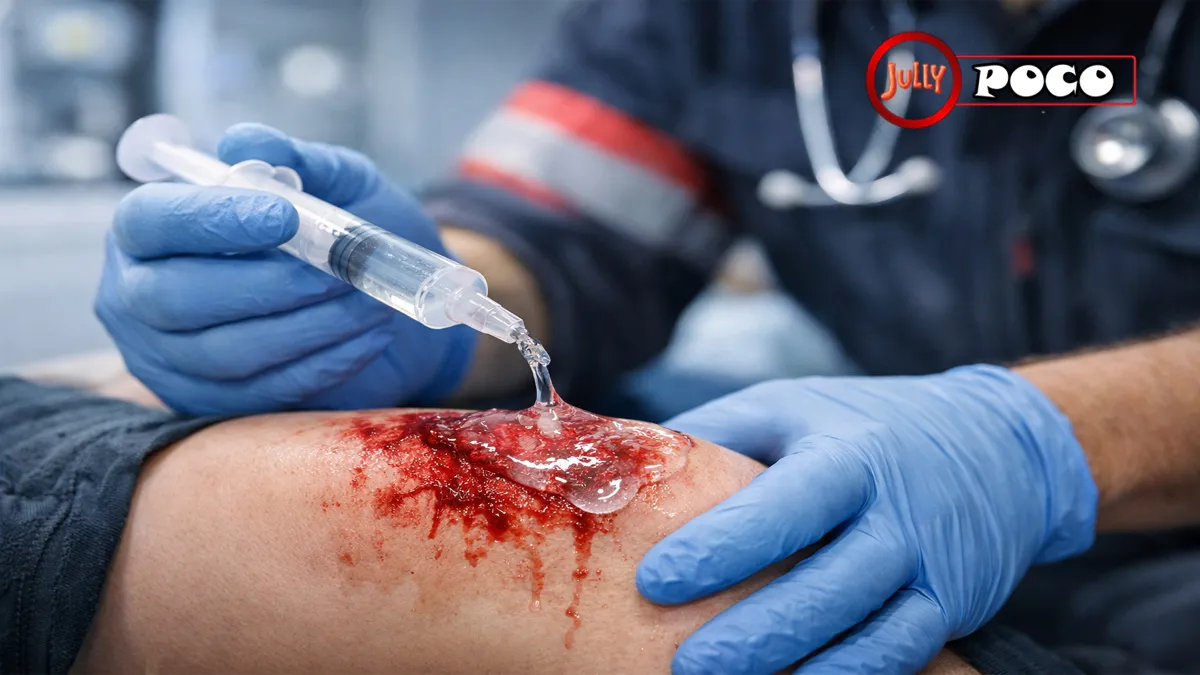
When bleeding happens fast and unexpectedly, every second matters. This is where TRAUMA GEL steps in as a real game-changer. Recently cleared by the FDA, this plant-based hemostatic gel is designed to rapidly stop moderate to severe bleeding without manual pressure. That makes it especially valuable for emergency responders, trauma teams, and even military medics working in chaotic environments. 🩺🚑
In this article, you’ll learn what is trauma gel, how it works, and the 7 amazing benefits that make it stand out from traditional gauze, dressings, and powders. We’ll also cover limitations, real-life examples, and common questions so you can understand whether TRAUMAGEL has a role in your emergency kit, ambulance, or trauma bay.
1. FDA-Approved Confidence for High-Stakes Emergencies
One of the most important benefits of TRAUMA GEL is its recent FDA approval. In trauma care, products must prove both safety and effectiveness before they earn that stamp.
FDA clearance means:
- The gel has undergone formal testing for safety.
- Its ability to help control bleeding has been evaluated.
- Its ingredients and manufacturing process meet strict standards.
This matters for:
- EMS agencies deciding what to stock in ambulances.
- Hospital trauma centers updating protocols.
- Military medical teams choosing gear for deployment.
When a product is FDA-cleared, medical directors and administrators feel more confident adding it to official guidelines. That can translate into broader access and consistent use, rather than relying on experimental or untested options.
For more background on how trauma devices are evaluated, the official information from the U.S. Food and Drug Administration on medical devices for emergency care offers useful context.
2. Plant-Based Polysaccharide Formula for Safer Hemostasis 🌿
Another stand-out benefit is that TRAUMA GEL is plant-based. Many traditional hemostatic agents rely on mineral compounds or animal-derived materials. Traumagel instead uses a proprietary polysaccharide blend derived from plant sources.
This plant-based design can offer several advantages:
- Reduced risk of immune reactions compared with some animal-derived products.
- No blood-derived components, which can reassure both clinicians and patients.
- Easier acceptance in settings with dietary, cultural, or religious concerns.
Polysaccharides are complex carbohydrates. In this context, they:
- Rapidly absorb fluid from blood.
- Swell and help form a thick hydrogel barrier on the wound surface.
- Provide a mechanical seal that supports clot formation.
Because TRAUMAGEL is based on a biocompatible plant matrix, it aims to balance strong performance with a reassuring safety profile.
For patients and providers who prefer or require plant-based medical products, this is a meaningful innovation compared with older generations of hemostatic dressings.
3. Immediate Hydrogel Barrier: No Manual Pressure Required
In many bleeding emergencies, traditional care means:
- Apply thick gauze.
- Press hard.
- Hold pressure for several minutes.
- Hope you are in the right spot and can maintain consistent force.
This is painful, difficult, and sometimes ineffective—especially with deep, irregular, or awkwardly located wounds.
TRAUMA GEL changes this process. Once applied, it:
- Forms a thick hydrogel that bonds to the wound surfaces.
- Creates an immediate mechanical barrier that helps halt bleeding.
- Does not require manual compression in many cases.
This “no manual pressure required” feature is one of its biggest practical benefits. It can:
- Free up the responder’s hands to manage airway, breathing, or other injuries.
- Reduce the struggle of holding pressure in a moving ambulance or helicopter.
- Lower the risk of disrupting early clot formation when pressure is released.
🔹 Real-life example:
An EMS crew responds to a car crash. The patient has a deep laceration in the groin area, a region where applying and maintaining strong manual pressure is difficult and uncomfortable. The medic uses a syringe of TRAUMAGEL, fills the wound cavity, and the hydrogel adheres quickly. The medic can then focus on airway support and IV access instead of fighting to keep a gloved fist in place.
This immediate sealing effect can help reduce blood loss during those critical early minutes before surgical care is available.
4. Fast, Simple Application in Chaotic Environments 🚑
In real trauma situations, conditions are rarely ideal. It might be:
- Dark
- Noisy
- Crowded
- Stressful
- Physically unstable (moving vehicles, helicopters, rubble)
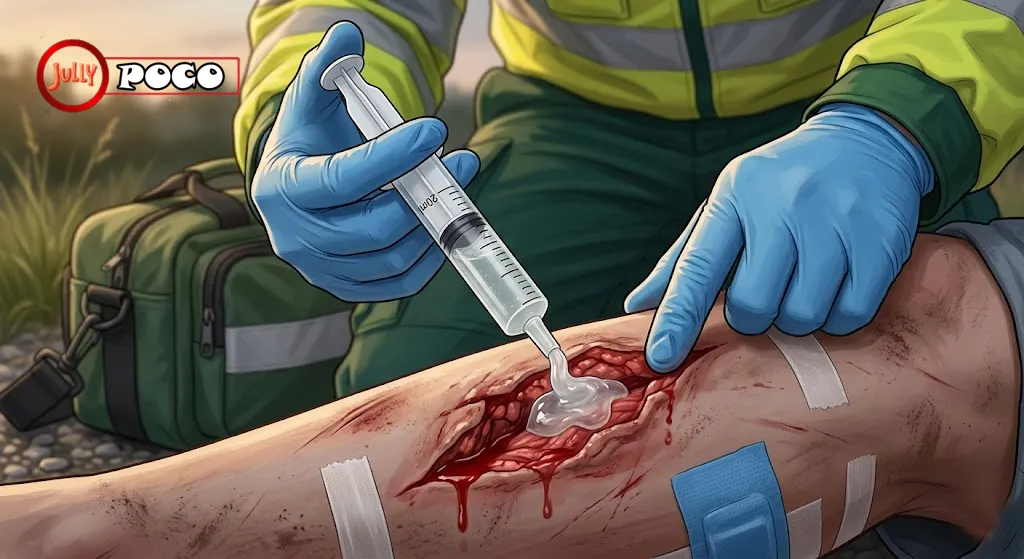
TRAUMAGEL is packaged in a sterile, single-use syringe designed for quick, intuitive application. This simplicity serves several groups:
- EMS teams in ambulances
- Firefighters or law enforcement acting as first responders
- Military medics in combat zones
- Disaster response teams during mass casualty incidents
Key advantages of this syringe-based design:
- Ready to use: No mixing, no special tools.
- Portability: Easy to carry on a belt, vest, trauma bag, or in a medic kit.
- Sterility: Single-use format reduces infection and cross-contamination risk.
- Clear workflow: Draw, expose, apply, and move on.
Because TRAUMA GEL is aimed at time-critical environments, the design reflects the reality that responders may have seconds, not minutes to act. When someone asks, “what is trauma gel actually like to use in the field?” the answer is: straightforward, fast, and built for pressure-filled scenarios.
5. Greater Patient Comfort and Less Painful Bleeding Control
Traditional bleeding control often hurts. Manual pressure over a wound, especially a deep or sensitive one, can be extremely painful for patients who are already scared, shocked, or struggling to breathe.
TRAUMAGEL aims to reduce pain and discomfort by:
- Avoiding the need for heavy, prolonged compression.
- Allowing a gentler, more targeted application into the wound.
- Providing a smooth hydrogel surface rather than rough packing materials.
This can make a major difference for:
- Deep or irregular wounds where gauze packing is very uncomfortable.
- Children, who may be more sensitive to pain and fear.
- Patients with multiple injuries, where any reduction in pain matters.
- Fragile skin (such as older adults) that bruises or tears easily under pressure.
🔹 Practical example:
A patient with a jagged arm laceration is conscious, anxious, and in pain. Instead of tightly packing gauze and pressing hard, the provider uses TRAUMAGEL to fill the wound. The hydrogel starts working without crushing pressure, and the patient reports less discomfort.
By reducing one major source of trauma-related pain, this gel can support better overall patient experience, even in the midst of a serious emergency.
For many clinicians, this is not just a comfort issue. Less pain can mean:
- Improved cooperation from the patient.
- Easier monitoring of mental status.
- Lower risk of agitation that can worsen bleeding or dislodge dressings.
6. Strong Clinical and Practical Impact Across Settings
TRAUMAGEL is not just for one niche. Its design makes it useful across multiple care environments:
a) Emergency Medicine & Pre-Hospital Care
For EMS and pre-hospital providers, TRAUMAGEL can:
- Stabilize patients faster before transport.
- Reduce on-scene time when bleeding control is otherwise difficult.
- Provide an option for wounds where tourniquets are not appropriate (e.g., torso, junctional areas).
This supports the core EMS goals: stop the bleeding, maintain circulation, and move the patient safely to definitive care.
b) Trauma Centers & Hospitals
In trauma bays and emergency departments, TRAUMAGEL may:
- Serve as a bridge to surgery, helping control bleeding while teams prepare.
- Reduce reliance on complex packing techniques.
- Assist in managing junctional or non-compressible wounds until surgeons can intervene.
Surgeons and emergency physicians often face the challenge of limited staff and many priorities in the first minutes of resuscitation. A fast-acting gel that controls bleeding with minimal supervision can be valuable.
c) Military & Disaster Response
In combat zones or disaster areas, TRAUMAGEL’s advantages are especially clear:
- Portable, rugged packaging fits in individual first aid kits or squad medic bags.
- Works well in dusty, unstable, or low-light settings.
- Reduces the need for prolonged manual pressure when medics must treat multiple casualties.
According to expert commentary in trauma and combat care literature, having simple, robust hemostatic tools is critical for field survival. Resources like the Committee on Tactical Combat Casualty Care on Tactical Combat Casualty Care guidelines highlight the importance of rapid hemorrhage control technologies in combat and tactical medicine.
Across these settings, TRAUMAGEL supports the same core outcome: faster bleeding control with less complexity, which can translate into better chances of survival.
7. Clear Advantages Over Traditional Dressings and Powders
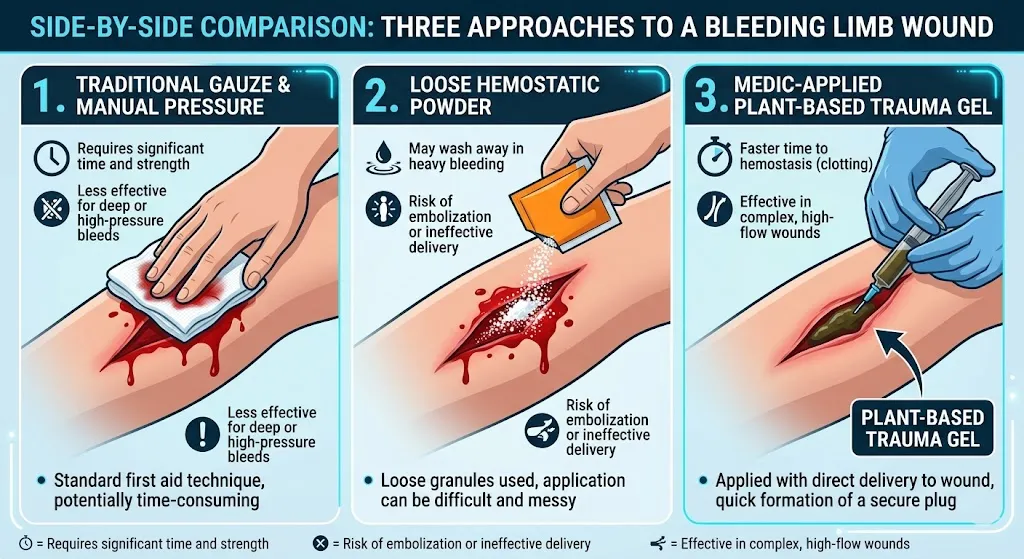
To understand the unique benefits of TRAUMAGEL, it helps to compare it with common alternatives.
Here is a simple overview:
| Feature | Traumagel (TRAUMA GEL) | Gauze / Pressure Dressings | Other Hemostatic Powders |
|---|---|---|---|
| FDA Approved | ✅ Yes | ✅ Yes | ✅ Some, not all |
| Plant-based | ✅ Yes (polysaccharide) | ❌ Usually synthetic or cotton | ⚠️ Mixed (varies by product) |
| Application Method | 💉 Syringe, direct to wound | 🩹 Manual pressure and packing | 🧂 Sprinkle or pour |
| Manual Pressure Required | ❌ Typically not | ✅ Often required | ⚠️ Sometimes needed |
| Speed of Action | ⚡ Immediate hydrogel seal | ⏱️ Slower, depends on pressure | ⚡ Fast, but less controlled |
| Control Over Placement | 🎯 High (targeted) | 🎯 Moderate | 🎯 Lower, can spread or blow away |
| Patient Comfort | 😊 High | 😣 Often painful | 🙂 Moderate |
| Sterility | ✅ Single-use syringe | ⚠️ Variable (depends on handling) | ⚠️ Variable |
| Ease of Use in Chaos | ✅ Very high | ⚠️ Moderate | ⚠️ Moderate |
This comparison shows how Traumagel’s syringe-based, plant-derived hydrogel stands apart from both:
- Traditional gauze dressings, which rely on manual pressure.
- Hemostatic powders, which can be less controlled and harder to contain.
The result is a more targeted, comfortable, and practical solution for many bleeding scenarios.
Limitations and Important Considerations ⚠️
Even with these benefits, TRAUMAGEL is not a magic cure-all. It has clear limitations that users must understand.
1. Scope of Use
TRAUMA GEL is designed for:
- Moderate to severe external bleeding
- Use on open wounds where the gel can contact tissue
It is not a replacement for:
- Surgical treatment of internal hemorrhage
- Definitive repair of major vascular injuries
- Advanced interventions like embolization or damage-control surgery
It should be viewed as a bridge: a way to stabilize bleeding until the patient reaches higher-level care.
2. Cost and Availability
As a newer product, TRAUMAGEL may face:
- Variable pricing between regions and buyers.
- Regional differences in distribution and stock.
- Budget questions for smaller EMS services or rural hospitals.
Over time, as more demand builds and more data is published, these issues may improve. For now, some organizations may need to evaluate cost–benefit carefully, possibly using the gel in selected high-risk situations.
3. Training Requirements
Although simple to use, TRAUMAGEL is still a medical device that demands proper training:
- Responders need to know when to use it.
- They must understand how much to apply.
- They should learn how to document its use for receiving hospitals.
Short in-service training sessions, simulation practice, or inclusion in stop-the-bleed training for professional responders can help ensure the gel is used to its full potential.
Quick FAQ About TRAUMA GEL and Traumagel
1. What is trauma gel, in simple terms?
Trauma gel, specifically TRAUMAGEL, is a plant-based hemostatic gel in a syringe. It is used to rapidly stop external bleeding by forming a hydrogel barrier over the wound, usually without needing manual pressure.
2. Is TRAUMA GEL safe for all patients?
TRAUMA GEL is FDA-approved, which supports its safety and effectiveness. However, like any medical product, it should be used according to labeling and protocols. Certain patients with unique allergies or conditions may require extra caution, so clinicians should always review official guidance.
3. Can non-medical people use TRAUMAGEL?
The product is primarily designed for EMS, trauma centers, and military medics. That said, its simple syringe application means that with proper training, trained lay responders might be able to use it in structured programs. Always follow local regulations and manufacturer recommendations.
4. Does TRAUMA GEL replace tourniquets?
No. Tourniquets are still vital for severe limb bleeding from major arteries. TRAUMA GEL can be used:
- Where tourniquets are not possible (groin, axilla, neck, torso).
- Alongside other tools as part of a comprehensive bleeding control strategy.
5. How does TRAUMAGEL compare to products like QuikClot or Celox?
TRAUMAGEL differs mainly in form (gel vs. gauze or granules) and its plant-based hydrogel barrier mechanism. It focuses on:
- No manual pressure
- Syringe-based targeted delivery
- Patient comfort
Direct head-to-head clinical trial data are still emerging. Many systems may choose to stock TRAUMAGEL alongside established agents as part of a layered toolkit.
6. Can TRAUMA GEL be used for minor cuts?
It can, but it may not be necessary. For minor bleeding, simple measures like direct pressure, small dressings, or adhesive bandages are usually enough. TRAUMA GEL is best reserved for moderate to severe bleeding where quick, strong control is crucial.
Conclusion: Why TRAUMA GEL Deserves a Place in Modern Trauma Care
TRAUMAGEL represents a major step forward in emergency bleeding control. By combining:
- FDA approval
- A plant-based polysaccharide formula
- A simple, sterile syringe delivery system
- No manual pressure in many situations
- High patient comfort
- Strong usefulness in EMS, trauma centers, military, and disaster response
it fills a critical gap between basic first-aid dressings and advanced surgical treatment.
While TRAUMA GEL is not a replacement for surgery or internal hemorrhage management, it offers a practical, portable, and effective solution for external moderate to severe bleeding. For medical directors, trauma coordinators, and field medics seeking reliable tools in high-stress environments, it is worth serious consideration.
If you are involved in emergency medicine, tactical care, or trauma system planning, reviewing your protocols and equipment to see where TRAUMAGEL might fit could help save lives and reduce suffering when it matters most. 🧡🩹
Note: This article is for informational purposes only and should not be considered medical advice. Please consult a qualified healthcare professional for personalized guidance.