


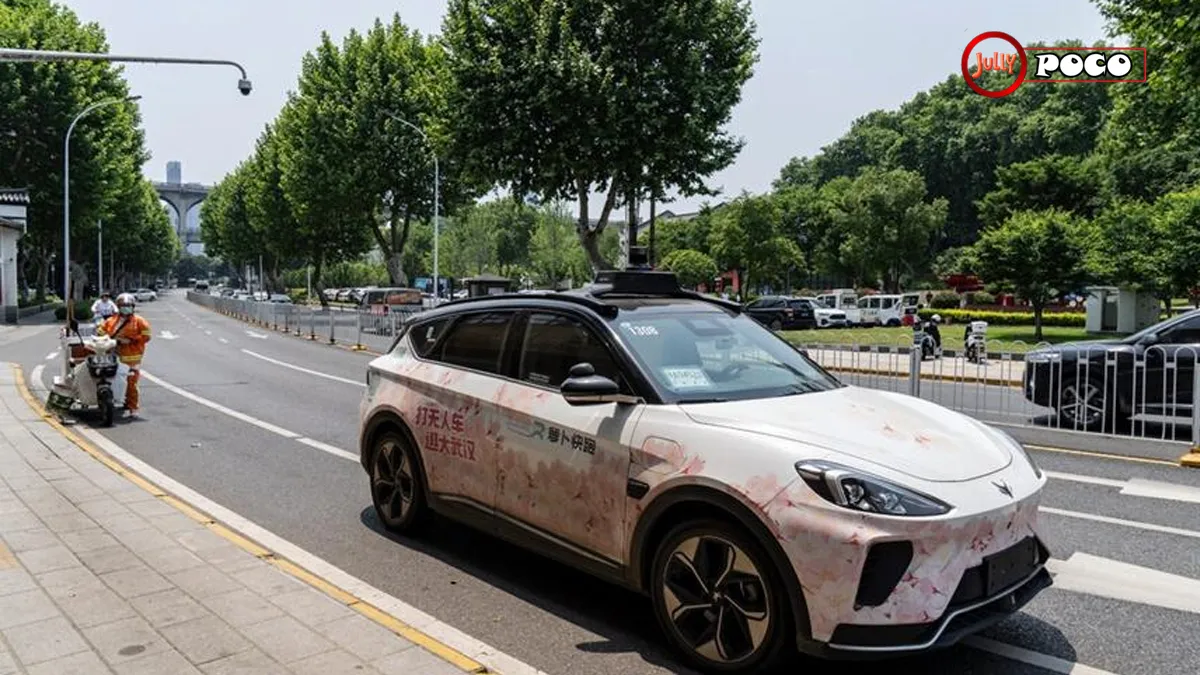
When people read robotaxi news, they often picture a smooth, futuristic ride. A car arrives quietly, opens its doors, and glides through the city without a driver. It feels like tomorrow has arrived early. But in Wuhan, that vision hit a troubling speed bump 🚖⚠️
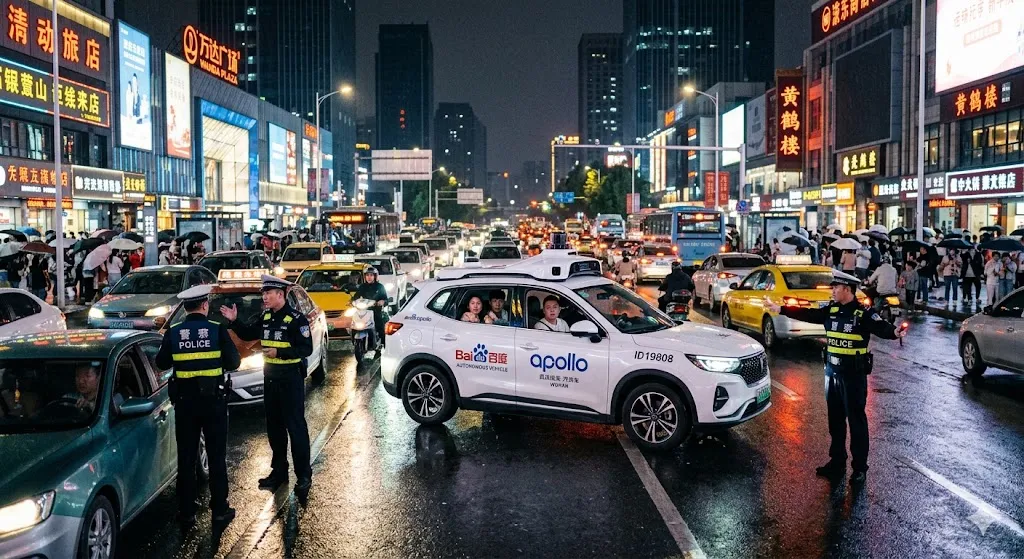
On a Tuesday night, several Baidu Apollo Robotaxis reportedly stalled on busy roads across Wuhan. Passengers were left stuck inside. Traffic backed up. Police received repeated emergency calls. Videos shared online appeared to show the cars stopped in unsafe locations, including active traffic lanes. For many observers, this was not just a technical glitch. It was a public test of trust, and trust looked fragile.
The incident comes at a sensitive moment. China has been moving quickly to scale China self-driving taxis, hoping to lead the world in autonomous mobility. Baidu, Pony.ai, and WeRide have all expanded pilots in major cities. At the same time, the global auto industry is preparing for the Beijing Auto Show, where electric vehicles and AI-powered systems will be front and center.
That timing matters. Because while autonomous transport promises convenience, lower labor costs, and smarter urban mobility, one stalled vehicle can be an inconvenience. Several stalled vehicles in a busy city can become a warning sign.
This article breaks down five key facts behind the Wuhan event and what they reveal about autonomous driving safety in China. We will also look at the broader industry context, compare this case with global examples, and explain why reliability may now matter more than hype.
1. Multiple Baidu Robotaxi Vehicles Reportedly Stalled in Busy Wuhan Traffic
The most alarming part of this story is simple. It was not one isolated failure.
Reports from Wuhan indicated that multiple Baidu Robotaxi vehicles stopped suddenly during active service. These vehicles were operating on city roads and carrying passengers at the time. Some reportedly halted in ways that blocked traffic. Others stranded riders in locations that looked unsafe, especially at night.
That detail changes everything.
A single vehicle issue can be written off as bad luck. A fleet-wide interruption points to something deeper. It suggests that the problem may have involved a shared system layer, such as software, communications, or remote dispatch support.
According to local reporting and social media accounts, the cars stopped due to a “system malfunction.” That phrase sounds mild. But in traffic, mild words can hide serious risk.
Imagine sitting inside a driverless cab while cars speed past your window. The vehicle will not move. You cannot solve the issue yourself. You do not know whether the system can restart. You are waiting for remote support or roadside help. That is not convenience. That is vulnerability.
Why this mattered so much
Several factors made the Wuhan situation especially serious:
- It happened on busy roads
- It occurred at night
- Passengers were inside the vehicles
- Traffic flow was disrupted
- Emergency services were pulled in
For a public still learning to trust autonomous transport, moments like this can shape opinion fast.
The promise of robotaxis is freedom from human error. But the public expects something else too: graceful failure. If a system fails, people want it to fail safely. That means pulling over in a secure spot, unlocking passengers quickly, and communicating clearly.
If videos and witness reports are accurate, that standard may not have been met.
2. The Police Response Exposed How Unprepared Cities May Still Be
One of the clearest signals from this case came from the emergency response itself. Wuhan traffic authorities reportedly received continuous calls as the incident unfolded. Officers then coordinated with Baidu staff to manage the disruption.
That tells us two things.
First, this was not a silent backend event. It was visible enough that regular people felt alarmed and contacted authorities. Second, local police still play a crucial role when driverless car incident events happen in the real world.
This is a reminder that autonomous mobility does not exist in isolation. It depends on a wider safety network:
- Traffic police
- Roadside assistance teams
- Remote operations centers
- Emergency dispatch systems
- Local transport regulators
When a robotaxi stalls, the question is not only whether the vehicle software can recover. The question is whether the city around it can recover too.
That is a much bigger challenge.
A driverless car still needs a human backup system
People often think robotaxis remove humans from the process. In reality, they shift human involvement behind the scenes.
For example:
- A remote operator may monitor unusual conditions
- Engineers may push software fixes
- Police may redirect traffic
- Customer support may guide passengers
- Maintenance teams may physically recover vehicles
This hidden support web is expensive and complex. It also becomes very visible when something goes wrong.
In the Wuhan event, police coordination appears to have been essential. That should prompt a harder question for the industry: Are cities scaling robotaxis faster than they are scaling response systems?
3. Baidu’s Large Wuhan Fleet Turned One Glitch Into a Citywide Safety Story
Baidu has deployed hundreds of autonomous taxis in Wuhan. That scale matters because it transforms a technical issue into a public event.
A city with only a few test vehicles can hide behind the phrase “pilot program.” But when robotaxis become a common sight, public expectations change. Residents begin to treat them like normal transport, not experiments.
That is exactly why this story gained attention in the latest robotaxi news cycle.
The larger the fleet, the greater the exposure:
- More riders affected
- More intersections involved
- More pressure on support teams
- More public videos shared online
- More reputational risk for the company
Scale is a double-edged sword. It proves confidence, but it also multiplies failure.
The growth of China self-driving taxis
China has become one of the world’s most active testing grounds for autonomous vehicles. Compared with some Western markets, Chinese cities have moved quickly on large pilot zones and commercial trials.
Key players include:
- Baidu Apollo Go
- Pony.ai
- WeRide
For readers tracking China self-driving taxis, the Wuhan incident is important because it shows what happens when deployment reaches everyday density. The problems are no longer theoretical. They show up in traffic, on phone cameras, and in emergency call logs.
That is the stage where public trust becomes the real currency.
Public trust is hard to build and easy to lose
Autonomous systems ask riders to surrender control. That is a psychological leap.
A human driver can reassure you. They can explain a delay, respond to danger, or improvise around road work. A robotaxi cannot offer emotional confidence in the same way. So every visible failure becomes more memorable.
This is true even if robotaxis are statistically safer over time. Human beings do not judge risk only by numbers. They judge it by stories, images, and moments of helplessness.
That is why incidents like the one in Wuhan travel so fast online 📱
4. The Official “System Malfunction” Explanation Leaves Major Questions Unanswered
The reported cause was a software or system malfunction. That explanation may be accurate, but it is still incomplete.
Software issues in autonomous fleets can mean many things:
- Sensor fusion failure
- Mapping mismatch
- Communication breakdown
- Fleet control outage
- Faulty update deployment
- Safety logic overreaction
Each type of failure carries different risks. Some are localized. Others can affect many vehicles at once.
That is why the lack of detailed public explanation matters.
When companies do not explain what happened, people fill the gap themselves. They assume the worst. Regulators also become more cautious. Investors grow uneasy. Competitors point to the event as proof that scale came too soon.
Why software failures feel different from mechanical failures
A flat tire affects one car. A bad software command can affect many cars.
That is the hidden risk in autonomous fleets. Their strength comes from shared intelligence, but their weakness can come from shared vulnerability.
Think of it like a citywide power grid. It is efficient when it works. But if the system fails at the wrong point, a very large area can go dark all at once.
The same principle applies here.
For autonomous driving safety, redundancy is everything. A robotaxi must detect failure, shift to a safe state, protect passengers, and avoid creating danger for others. If that chain breaks, even briefly, the road becomes less predictable.
Silence can deepen reputational damage
At the time described in the summary, Baidu had not issued an immediate public response with full technical detail. In crisis communication, delay has a cost.
People usually want answers to basic questions:
- What exactly failed?
- How many vehicles were affected?
- Were passengers ever in immediate danger?
- What safeguards activated?
- What changes will prevent this from happening again?
Without those answers, the incident remains open in the public mind.
For anyone following autonomous driving safety, this is where transparency becomes as important as engineering.
5. This Was Not an Isolated Warning Sign in the Global Robotaxi Race
The Wuhan event feels local, but the pattern is global.
Autonomous vehicle companies around the world have faced software outages, emergency stop problems, confusing road behavior, and public trust setbacks. The technologies differ. The roads differ. But the core lesson stays the same: real-world driving is messy.
The summary compares the Wuhan case with other notable examples:
- Waymo reportedly experienced a prolonged outage in Phoenix in December 2025
- A Xiaomi SU7 crash in China in 2023 raised wider regulatory concerns
- Tesla’s advanced driver-assist systems continue to face scrutiny worldwide
These examples matter because they show a broader truth. The race to commercialize autonomy is not only about innovation. It is about edge cases.
Edge cases are where trust gets tested
An autonomous system may perform well in routine traffic. But roads are full of surprises:
- Temporary construction lanes
- Poor weather
- Night glare
- Aggressive drivers
- Unclear signage
- Unusual pedestrian movement
Humans are imperfect, but they are flexible. Machines are consistent, but they can be brittle.
That brittleness is what many recent incidents expose.
Quick comparison of recent autonomous safety concerns
| Incident | Location | Reported Issue | Public Impact | Broader Lesson |
|---|---|---|---|---|
| Baidu Apollo Robotaxi stall | Wuhan, China | System malfunction | Passengers stranded, traffic blocked | Fleet reliability remains a major concern |
| Waymo outage | Phoenix, U.S. | Vehicles pulled over during outage | Service disruption | Remote systems can become a weak point |
| Xiaomi SU7 crash | China | Fatal crash involving autonomous mode concerns | Regulatory alarm | Advanced systems require tighter oversight |
| Tesla driver-assist scrutiny | Global | Misuse and system-limit concerns | Ongoing debate | Marketing and user understanding matter |
This is why the current robotaxi news conversation is larger than one company. It is about whether autonomous mobility can earn social permission to scale.
Why the Wuhan Incident Is Especially Embarrassing Before the Beijing Auto Show
Timing shapes headlines. And this incident came just weeks before the Beijing Auto Show in April 2026.
That makes the story more than a safety issue. It makes it symbolic.
Automakers are preparing to showcase the future:
- Smarter EV platforms
- AI-enabled cabins
- Assisted and autonomous driving features
- New urban mobility concepts
China wants to show momentum. Baidu wants to show leadership. But a public stall event sends the opposite message. It says the future still has loose wiring.
That does not mean the technology is doomed. It means the industry may be ahead in ambition and behind in dependability.
Innovation is not the same as readiness
This distinction matters.
A demo can impress. A pilot can excite. A citywide service must endure boring reality every day. That means:
- Rush hour
- Night shifts
- software updates
- impatient traffic
- emergency vehicles
- infrastructure inconsistencies
Consumers do not measure progress by prototypes. They measure it by whether they arrived safely and on time.
That is where Baidu Robotaxi services now face a serious image challenge.
What This Means for Regulation in China
Chinese regulators have shown both ambition and caution on autonomous vehicles. They support testing and pilot expansion, but they have also slowed or delayed commercialization after high-profile safety events.
The Wuhan case may increase pressure in several areas:
- More rigorous incident reporting
- Tighter software update oversight
- New passenger protection rules
- More limited operating zones
- Delays in broader approvals
That would not be surprising. Governments tend to respond strongly when public safety incidents become visible online and politically sensitive.
Regulation often tightens after trust cracks
This pattern appears in many industries. Aviation, medicine, railways, and autonomous driving all follow a similar rule. Progress accelerates until a failure exposes the weak spots. Then standards harden.
In that sense, Wuhan may become a case study.
For readers tracking Baidu Robotaxi, the bigger issue is not just one malfunction. It is whether this event changes the pace of expansion in China and abroad.
Baidu has already discussed international plans, including supplying autonomous taxis to Lyft in the U.S. and expanding to Germany and the UK, subject to approval. Those ambitions depend on one thing above all: confidence.
And confidence is built through repeated safe performance, not bold announcements.
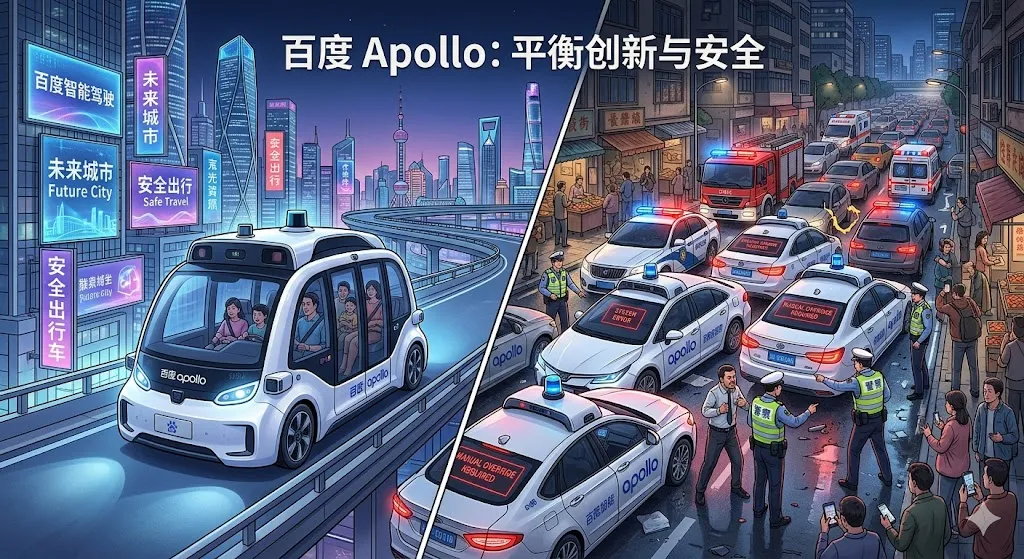
The Real Safety Risks Passengers Should Understand
For many readers, the biggest question is practical: What are the actual risks if a robotaxi stops unexpectedly?
Here are the most immediate concerns.
Passenger safety risks
- Being stranded in an active traffic lane
- Delayed exit or unclear instructions
- Exposure to rear-end collision risk
- Anxiety during night-time incidents
- Limited ability to override the system
Road safety risks
- Sudden traffic obstruction
- Confusion for nearby drivers
- Emergency response delays
- Chain-reaction braking
- Added risk in high-speed corridors
Long-term system risks
- Reduced public confidence
- Lower adoption rates
- Regulatory slowdown
- Higher insurance and operating costs
- Reputational damage to the wider sector
A useful way to think about it is this: self-driving taxis are like elevators. Most people do not understand the mechanics. They trust the system because it is predictable, regulated, and boring. The day the ride stops between floors, trust drops immediately.
Autonomous cars need to reach that “boring and dependable” standard. Right now, the industry is not fully there.
Can China Still Lead in Autonomous Mobility?
Yes, but leadership now depends on discipline more than speed.
China has several advantages:
- Large urban test environments
- Strong EV supply chains
- Supportive local pilot policies
- Deep AI investment
- Consumer familiarity with digital transport platforms
Those are real strengths. They may help China remain a major force in autonomous mobility.
But scale without reliability is risky.
If China self-driving taxis become associated with sudden failures, blocked roads, or poor communication during emergencies, public enthusiasm could cool quickly. That would hurt not just one operator, but the whole ecosystem.
The next stage of competition may not be “who launches first.” It may be “who fails safest.”
What Companies Must Do Next
The industry cannot rely on excitement alone. After incidents like Wuhan, several steps become essential.
1. Improve failure handling
If a system goes down, the vehicle should move to the safest possible position. That must happen fast.
2. Communicate clearly with passengers
Riders need instant updates, calm instructions, and easy contact with support.
3. Publish transparent incident reports
Companies should explain what happened in simple language. Silence creates fear.
4. Expand independent oversight
Third-party testing and audits can improve public trust.
5. Train cities, not just vehicles
Local responders must know how to handle robotaxi disruptions safely.
These are not optional polish items. They are part of real-world deployment.
FAQs
What happened in the Wuhan Baidu robotaxi incident?
Multiple Baidu Apollo Robotaxis reportedly stalled on busy roads in Wuhan due to a system malfunction. Passengers were stranded, and traffic was disrupted.
Was anyone injured in the Baidu Robotaxi event?
The summary does not confirm injuries. However, the vehicles reportedly stopped in unsafe lanes, which raised serious safety concerns.
Why is this incident important for autonomous driving safety?
It shows that software failures in large fleets can affect both passengers and surrounding traffic. It also highlights the need for safer fallback systems.
Are China self-driving taxis still expanding?
Yes. China continues expanding pilot programs through Baidu, Pony.ai, and WeRide. But incidents like this may lead to stricter regulation.
How does this compare with Waymo or Tesla issues?
Like recent Waymo and Tesla concerns, the Wuhan case shows that autonomous systems still struggle with reliability, edge cases, and public trust.
Could this affect Baidu’s international expansion plans?
Potentially, yes. Regulators and partners in other countries may look more closely at safety performance before approving expansion.
Conclusion: Robotaxi News Is No Longer Just About Innovation
The latest robotaxi news from Wuhan offers a sobering lesson. Autonomous taxis are not judged only by how well they drive when conditions are easy. They are judged by what happens when systems fail.
In this case, the reported Baidu Robotaxi malfunction exposed a hard truth. Driverless mobility can look polished in presentations and still feel fragile on public roads. Passengers were stranded. Traffic was blocked. Police had to step in. And a major technology story became a public safety story.
That does not erase the promise of autonomous transport. It simply makes the standard clearer. Reliability must come before scale. Transparency must match ambition. And autonomous driving safety must be treated as the foundation, not a feature.
As China prepares to showcase the future of EVs and AI at the Beijing Auto Show, this incident stands as a reminder 🚘🤖: progress is real, but trust is earned one safe ride at a time.
If you follow robotaxi news, this is the moment to watch closely. The next chapter will not be written by marketing claims. It will be written by how companies respond, improve, and protect the people already inside the car.
References
- Reuters – global reporting on autonomous vehicles and China mobility trends: https://www.reuters.com/
- NHTSA – automated vehicles safety guidance: https://www.nhtsa.gov/vehicle-safety/automated-vehicles-safety
- Baidu – company and Apollo platform information: https://www.baidu.com/


Job Title: Founder, Chief Editor & Senior Technical SEO Specialist
Institutional Affiliation: Jullypoco Digital Properties
Specialties: Technical Search Engine Optimization | Content Strategy & Publishing | Web Architecture
Muhammad Ali is a seasoned digital content strategist, technical SEO professional, and the founder of Jullypoco. With deep expertise in website management, domain optimization, and search architecture, he orchestrates high-impact editorial frameworks designed to connect global audiences with reliable, high-value information. His commitment to search integrity and evidence-based optimization ensures the highest standards of data accuracy and site performance.
Verify Credentials & Connect:
🌐 Official Jullypoco Author Hub |
💼 LinkedIn Professional Profile |
👥 Facebook Profile
2 Comments
Pingback: Pistachio Tree: 7 Powerful Reasons Why It Is Truly Unique
Pingback: Car Airbags: 7 Powerful Facts About How They Work and Save Lives