

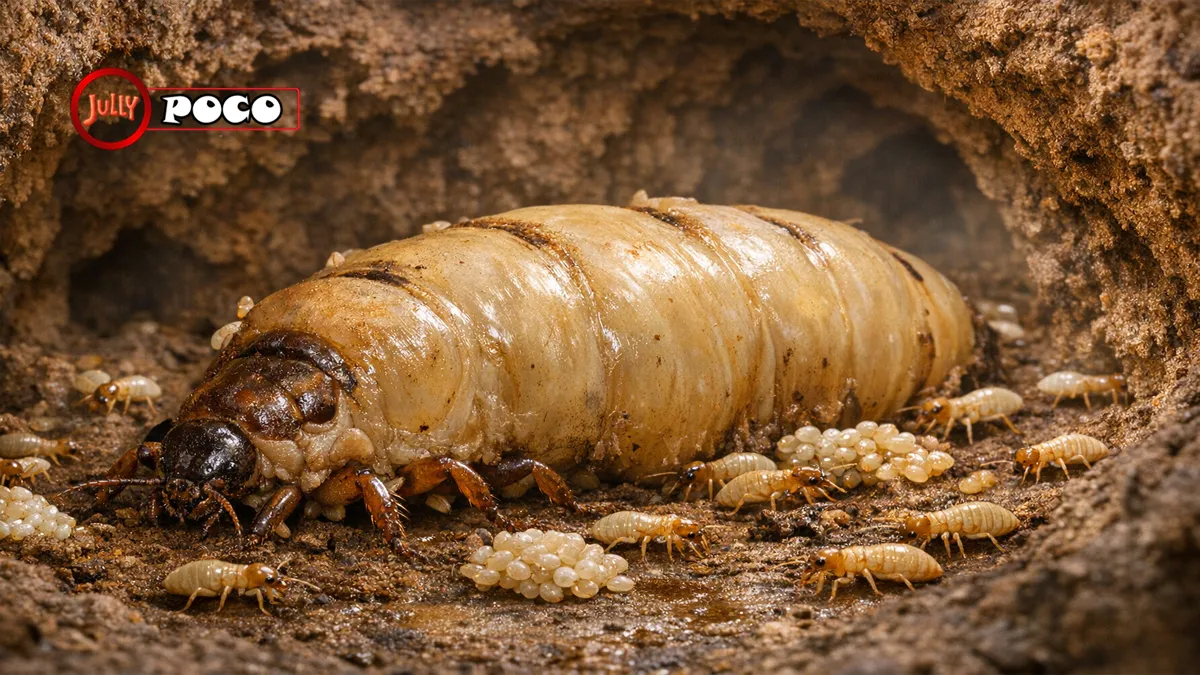
When most people think about termites, they picture tiny insects chewing through wood in silence. But hidden deep inside the colony is the real force behind that damage: the Termite Queen 👑🐜. She is not just another insect. She is the biological engine of the colony, capable of living for decades, producing millions of eggs, and growing to a size that seems almost unbelievable.
That combination of scale, lifespan, and reproductive power makes her one of nature’s most remarkable survival specialists. In some species, she can live up to 50 years. In the largest tropical colonies, her swollen body may stretch close to 6 inches long. Compared with her workers, she looks almost unreal.
This article explores seven surprising secrets about the termite monarch, from her extraordinary body transformation to the chemical signals that keep the colony organized. If you have ever wondered why termite colonies become so large, so persistent, and so difficult to eliminate, the answer often begins with the queen.
Why the termite queen matters more than most people realize
A termite colony is built around teamwork, but its future depends on reproduction. That is why the queen sits at the center of the system. Without her, the colony cannot sustain itself for long.
Her role includes:
- Laying eggs continuously
- Supporting colony expansion
- Maintaining social order through pheromones
- Helping the colony survive across many years
In practical terms, one queen can help grow a colony from around 1,000 workers to more than 300,000 termites in only a few years. That growth explains why early termite problems can become serious structural threats if ignored.
For a broader look at termites and their social biology, Britannica offers a strong scientific overview.
1. The termite queen can become enormous
The first secret is the one that surprises most readers: the queen can become huge.
When people ask about termite queen size, they are usually imagining something only slightly larger than a worker. The truth is far more dramatic. In some tropical species, the queen can grow up to 6 inches long. That makes her the biggest member of the colony by a wide margin.
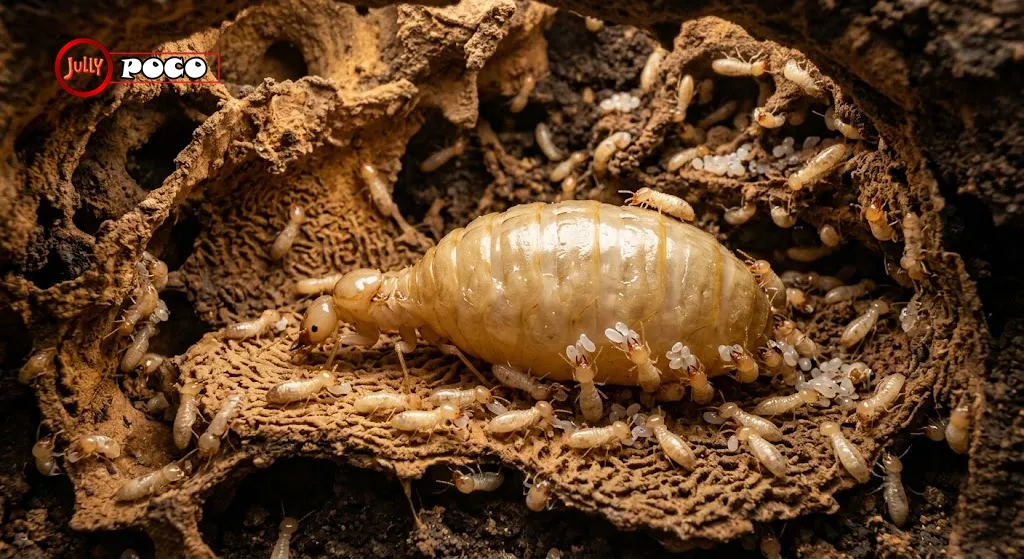
Her size does not come from muscle or speed. It comes from reproduction. Her abdomen expands over time as her egg-producing organs develop. This process is called physogastry, and it turns her into a living egg factory.
What she looks like
A queen often has these features:
- Color ranging from pale yellow-brown to black
- A greatly enlarged abdomen
- A soft, stretched body
- Limited or no mobility
- Constant care from worker termites
The enlarged abdomen may even appear to pulse as eggs move through her body. It is an unsettling image, yet biologically brilliant.
Why size matters
Her body is built for one main purpose: sustained egg production. The larger the abdomen, the greater her reproductive output can be. In that sense, her giant form is not a weakness. It is an adaptation.
Think of it this way. Worker termites are like builders. Soldiers are like guards. The queen is like the colony’s manufacturing plant, operating day and night.
2. She is one of the longest-living insects on Earth
The second secret is her astonishing longevity ⏳.
The average termite worker lives only one to two years. Many insects survive for mere weeks or months. The queen, by contrast, may live 25 to 50 years, depending on species and environmental conditions. That makes termite queen lifespan one of the most impressive in the insect world.
This is not a small biological footnote. It is a major reason colonies can remain active for so long.
Why her lifespan is so important
A long-lived queen gives the colony:
- Reproductive stability
- Time to expand into large networks
- A consistent chemical leader
- Better chances of surviving environmental change
A queen that survives for decades can keep producing generation after generation without interruption. That creates colonies with deep resilience.
Peak production years
Even though she can live for decades, her peak egg output usually occurs during the first 7 to 10 years of her reproductive life. During that time, the colony often grows fastest.
In warmer climates, she may continue laying eggs year-round. In cooler climates, production often slows during winter.
For readers who want a trusted pest-focused source on termite queen biology and colony structure, Orkin provides accessible background information.
3. She can lay thousands of eggs every single day
This is the third and perhaps most jaw-dropping secret: the queen is one of the most prolific egg producers in nature 🥚.
Depending on the species, she can lay anywhere from 1,000 to 30,000 eggs per day. Over a lifetime, that total may exceed 9 million eggs.
That level of output is difficult to picture. A small insect creating entire generations every day sounds like science fiction. Yet it is real.
Daily and lifetime production at a glance
Here is a quick comparison table for easy reference:
| Feature | Termite Queen Details |
|---|---|
| Size | Up to 6 inches long |
| Color | Pale yellow-brown to black |
| Lifespan | 25–50 years |
| Eggs per Day | 1,000–30,000 |
| Lifetime Eggs | 9+ million |
| Mobility | Immobile, cared for by workers |
Why such high egg production matters
A colony depends on constant replacement. Workers die. Soldiers die. Young termites must develop into new laborers, defenders, and future reproductives.
The queen’s output allows the colony to:
- Recover from losses
- Expand into new feeding areas
- Maintain workforce numbers
- Strengthen long-term survival
A practical example helps. If a colony loses part of its worker force due to disturbance, the queen’s steady egg-laying can help rebuild those numbers over time.
4. The queen controls the colony with invisible chemical signals
The fourth secret is less visible, but just as important. The queen does not lead through sound or movement. She leads through chemistry.
She releases pheromones that influence the development and behavior of other termites. These chemical signals help prevent other termites from becoming rival queens. That keeps the social order stable.
How pheromones maintain hierarchy
The queen’s pheromones help:
- Suppress reproductive competition
- Signal her presence to the colony
- Support division of labor
- Reinforce colony structure
Without these signals, the colony could become disorganized. With them, termite society functions with striking efficiency.
Why this matters in real life
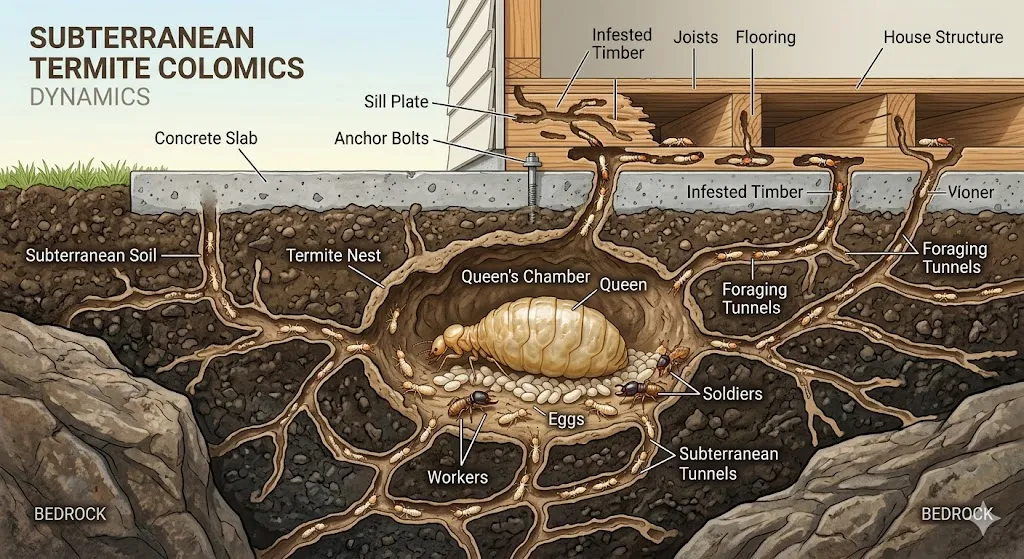
This is one reason termite colonies are so difficult to defeat without thorough treatment. Killing visible workers is often not enough. If the queen survives, the colony may continue functioning and rebuilding.
That is why professional pest control focuses on the colony system rather than only surface activity.
For science-based household guidance on termites and control options, the U.S. Environmental Protection Agency offers reliable information.
5. She cannot survive alone, despite her power
This fifth secret reveals a fascinating contradiction. The queen is the colony’s most important termite, yet she is also one of its most dependent members.
Because of her massive abdomen, she becomes largely immobile. She cannot move freely, forage, or defend herself. She depends completely on workers for survival.
Workers handle everything around her
Worker termites typically:
- Feed the queen
- Groom her body
- Carry away eggs
- Protect the royal chamber
- Maintain ideal moisture and temperature conditions
So while the queen produces the colony’s future, workers make that production possible.
A simple analogy
Imagine a seed-producing tree that cannot access sunlight or water by itself. It still creates life, but only because a whole support system keeps it alive. That is the queen’s reality.
This dependence also explains why termite colonies behave like one organism rather than a loose group of insects. Every caste depends on the others.
6. The biggest termite queen belongs to tropical species
The sixth secret focuses on scale and geography 🌍.
When people search for the biggest termite queen, they are usually looking for the most extreme examples found in nature. Those record-holding queens are often found in tropical species, where warm temperatures and favorable conditions support year-round reproduction.
In those environments, queens can reach extraordinary body size and produce tens of thousands of eggs each day.
Why tropical species grow larger queens
Several factors help explain this:
- Warm climates allow continuous reproduction
- Colonies can grow larger and faster
- Food resources may be more stable
- Environmental conditions support long-term expansion
In tropical ecosystems, termite societies often become vast and highly organized. A giant queen is a natural result of that success.
A proportionally astonishing insect
Compared with her workers, the queen can appear almost absurdly oversized. In proportional terms, she rivals some of the most extreme body transformations in the animal world.
That contrast is why termite queens often fascinate biologists. They show how evolution can reshape an insect body around one dominant function.
7. If the queen thrives, the colony can become destructive fast
The seventh secret brings us back to why this matters for homeowners, property managers, and anyone concerned about structural damage.
The queen’s longevity and reproductive output do not just make her fascinating. They make her dangerous in the context of infestations.
A healthy queen can support a colony large enough to cause major damage to:
- Wooden framing
- Floors
- Support beams
- Furniture
- Paper-based materials
Because termites often work out of sight, people may not notice the problem until the colony is already well established.
How colonies grow so quickly
With a productive queen, a colony can expand from about 1,000 workers to more than 300,000 in a few years. That growth creates more feeding pressure and more hidden tunnels.
A small early infestation may seem minor. But if the queen remains active, the colony often keeps growing in silence.
Why professionals target the colony, not just the symptoms
Seeing a few termites near a window or wall is only part of the story. The deeper issue is the reproductive center hidden away from view.
That is why professional treatment often aims to:
- Eliminate the queen or reproductive core
- Interrupt feeding paths
- Collapse the colony over time
- Prevent future re-establishment
From an inspection standpoint, understanding queen biology helps explain why termite control requires patience and strategy, not just surface spraying.
A closer look at termite queen size, color, and behavior
Before moving to the FAQs, it helps to summarize the queen’s physical and behavioral traits in plain language.
Appearance summary
Most queens share these characteristics:
- Much larger than workers and soldiers
- Soft-bodied and swollen in the abdomen
- Pale yellow-brown to dark brown or black
- Hidden in a protected royal chamber
- Surrounded by attendants at all times
Behavior summary
She spends most of her life:
- Laying eggs
- Releasing pheromones
- Remaining protected underground or inside wood
- Relying on workers for food and care
In short, she is not a roaming insect. She is the colony’s reproductive heart.
Why the termite queen is a biological marvel
It is easy to focus only on the damage termites cause. But from a scientific perspective, the queen is extraordinary.
She combines traits that rarely appear together in one insect:
- Massive body size
- Extreme longevity
- Continuous fertility
- Social control through chemistry
- Complete dependence on a support caste
These features make her one of the clearest examples of specialization in nature. Every part of her biology points toward one goal: keeping the colony alive across decades.
That is also why researchers study termite societies to better understand social evolution, aging, chemical communication, and insect development.
FAQs about the termite queen
1. How big can a termite queen get?
A queen can grow up to 6 inches long in some tropical species. This extreme termite queen size makes her much larger than workers and soldiers.
2. How long does a termite queen live?
The termite queen lifespan can range from 25 to 50 years. That makes her one of the longest-living insects known.
3. How many eggs does a termite queen lay per day?
Depending on the species, she may lay between 1,000 and 30,000 eggs daily. Her lifetime total can exceed 9 million eggs.
4. Can a termite colony survive without the queen?
Not for long. Without the queen’s egg production and pheromones, the colony loses its reproductive center and social stability.
5. Where is the queen found in a termite colony?
She usually stays in a protected royal chamber deep inside the nest, underground, or within wood. Workers constantly care for her there.
6. What is the biggest termite queen ever recorded?
The biggest termite queen examples are typically found in tropical species, where queens can approach 6 inches in length and produce very high numbers of eggs.
Final thoughts: the termite queen is both fascinating and formidable
The Termite Queen is one of the most remarkable insects on Earth. She can reach astonishing size, live for decades, and produce millions of eggs across her lifetime. Her chemical signals help maintain order. Her body is built for reproduction. And her survival shapes the fate of the entire colony.
That is what makes her so important. She is not just another insect in the nest. She is the colony’s engine, its founder, and its future.
For homeowners, that knowledge also carries a practical lesson. A thriving Termite Queen can support a growing colony that damages wood quietly and steadily. If you suspect termite activity, a professional inspection is the safest next step. Early action can prevent a small hidden problem from becoming a major structural one.
References
If you want, I can also turn this into:
- a WordPress-ready blog format,
- an HTML article with schema markup, or
- a Rank Math-friendly version with FAQ schema and slug suggestions.