


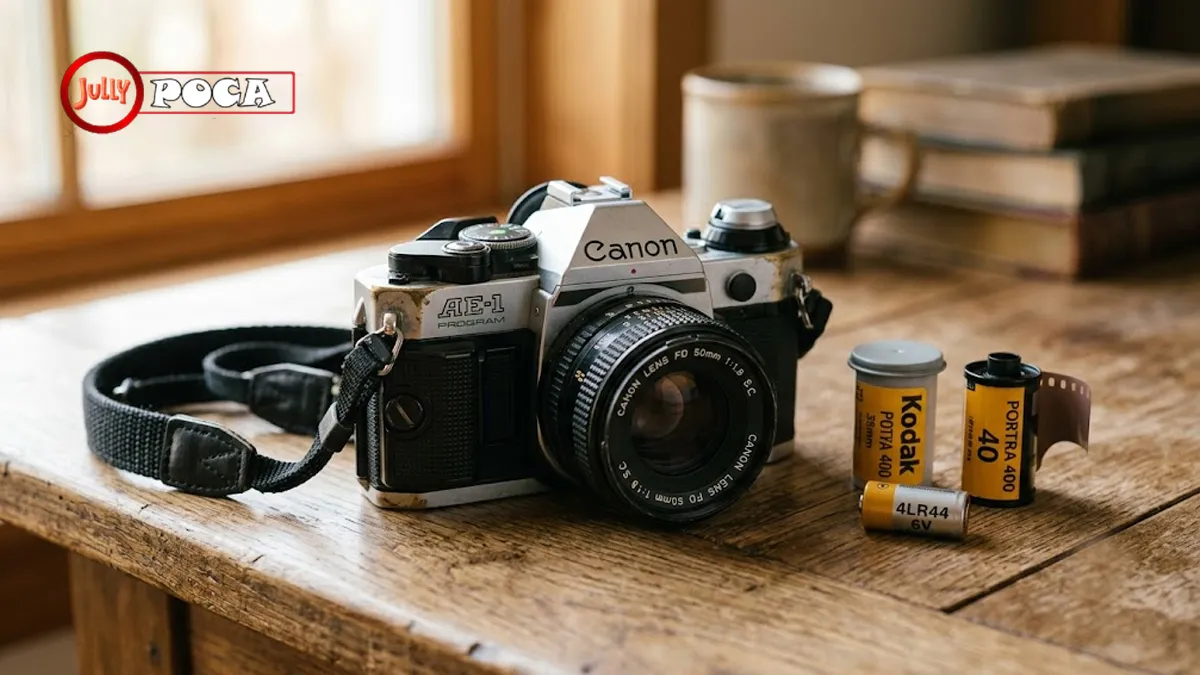
The Canon AE-1 Program film camera is one of those rare vintage tools that still feels approachable decades after its release. I’ve used many 35mm film bodies over the years, but this one has a particular charm: it makes film photography feel less intimidating without removing the tactile joy of shooting manually.
Released in 1981, the Canon AE-1 Program followed the hugely successful Canon AE-1 from 1976. The original AE-1 helped bring microprocessor-controlled exposure to everyday photographers. The Program version made things even easier by adding full Program AE mode.
That matters today.
If you are new to film, you probably want a camera that lets you learn without punishing every mistake. If you are experienced, you want reliability, lens choice, and a satisfying shooting experience. This canon ae 1 program review looks at both sides honestly.
We tested the camera in everyday situations: street walks, family portraits, bright daylight, indoor window light, and slow weekend shooting. I noticed quickly why the canon ae 1 program film camera remains one of the best vintage film cameras for beginners.
It is not perfect. But it still makes a strong case for itself.
📸 1. The Evolution: Canon AE-1 vs. AE-1 Program
The Canon AE-1 changed consumer photography in the late 1970s. It was affordable, electronic, and easy to use. Canon also leaned heavily into automated manufacturing, which helped make the camera widely available.
The canon ae 1 program took that foundation and added a more beginner-friendly exposure system.
The key difference is Program AE. On the original AE-1, you mainly worked with shutter-priority auto exposure or manual control. On the AE-1 Program, you can let the camera choose both shutter speed and aperture.
That does not sound revolutionary now. Every phone does this instantly. But in 1981, this was a major usability leap for a vintage 35mm SLR camera.
In my experience, the Program mode is what makes this camera feel welcoming today. You can walk outside, set the shutter dial to PROGRAM, set the lens aperture to “A,” focus manually, and shoot.
That simplicity is valuable.
| Feature | Canon AE-1 | Canon AE-1 Program |
|---|---|---|
| Release year | 1976 | 1981 |
| Exposure modes | Manual, shutter-priority AE | Manual, shutter-priority AE, Program AE |
| Viewfinder display | Needle/pointer system | LED aperture readout |
| Focusing screen | Fixed split-image | Interchangeable, brighter Laser Matte screen |
| Grip | Flat front body | Removable front action grip |
| Best for | Learners who want more manual control | Beginners and casual film shooters |
The Program model also feels slightly more refined in the hand. The small front grip is simple, almost modest, but it helps. Older flat-front SLRs can feel slippery after a few rolls. The AE-1 Program feels more secure.
Canon’s official history through the Canon Camera Museum shows how central the A-series was to Canon’s film-era identity.
🛠️ 2. Key Specifications & Architecture
The Canon AE-1 Program film camera is a 35mm single-lens reflex camera. It uses Canon FD and FDn lenses, not modern Canon EF autofocus lenses. That point is important because many buyers assume “Canon lens” means universal compatibility.
It does not.
Canon FD lenses are manual-focus lenses designed for Canon’s older film SLR bodies. The lens ecosystem is one of the biggest reasons this camera remains appealing. You can find sharp, character-rich glass at reasonable prices, especially compared with some Nikon, Leica, or Contax vintage systems.
Core specifications include:
- Camera type: 35mm SLR film camera
- Lens mount: Canon FD / FDn mount
- Shutter: electronic cloth focal plane shutter
- Shutter speeds: 2 seconds to 1/1000 second, plus Bulb
- Film speed range: ASA/ISO 12 to 3200
- Battery: 4LR44 or PX28 6V battery
- Exposure modes: Manual, shutter-priority AE, Program AE
- Flash sync: 1/60 second
The shutter is electronically controlled. This gives the camera accurate timing when it works properly. But it also means the camera depends completely on battery power.
⚠️ Crucial Battery Dependence
This is one of the first things I check when buying or testing a Canon A-series body.
If the battery dies, the camera will not fire. The shutter does not work mechanically as a backup. You need a working 4LR44 battery replacement or equivalent PX28-style 6V battery.
I always keep a spare in my camera bag. It is small, cheap, and prevents a ruined photo walk.
A weak battery can also make the camera behave strangely. If you are troubleshooting inconsistent firing, meter issues, or a dead shutter, start with the battery before assuming the worst. This is basic Canon A-series camera troubleshooting, but it saves a lot of anxiety.
Canon FD Lens Compatibility
The AE-1 Program works with Canon FD breech-lock lenses and newer FDn bayonet-style lenses. Both are manual focus. Both can be excellent.
Common beginner-friendly choices include:
- Canon FD 50mm f/1.8: affordable, sharp, light
- Canon FD 28mm f/2.8: useful for street and travel
- Canon FD 135mm f/3.5: compact portrait and detail lens
- Canon FD 35mm f/2.8: natural documentary perspective
If you want deeper technical background, the Canon FD lenses compatible reference gives a useful overview of the mount family.
I recommend starting with the 50mm f/1.8. It keeps the camera balanced, focuses smoothly, and gives you the classic film look people often want when they return to analog photography.
🎯 3. The “Program” Advantage: How It Works
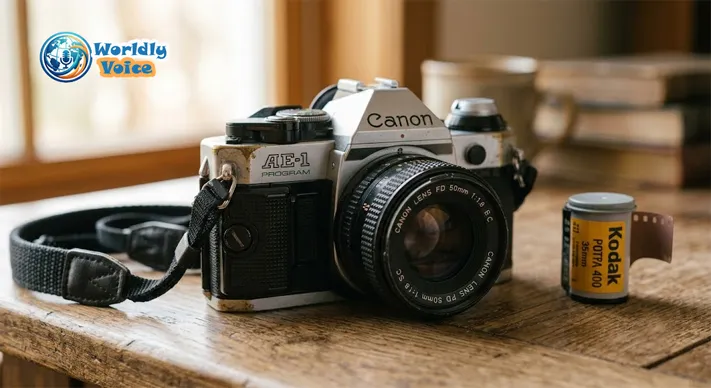
The Program mode is the feature that gives this camera its name.
Here is the simple setup:
- Turn the shutter speed dial to the green “PROGRAM” setting.
- Set the aperture ring on the FD lens to the green “A” mark.
- Focus manually.
- Compose and shoot.
The camera’s internal electronics read the light and choose a matching shutter speed and aperture. In plain terms, it handles exposure while you handle the photograph.
That is why the canon ae 1 program film experience feels so beginner-friendly.
When I hand this camera to someone shooting film for the first time, I usually start them in Program mode. They learn loading, focusing, framing, and film discipline first. Later, we move into shutter-priority and manual exposure.
That learning path works.
It lets beginners avoid the full exposure triangle on day one. They can still learn it later, but the camera does not demand everything at once.
This matters because film already has friction. You only get 24 or 36 exposures. You wait for processing. Mistakes cost money. A forgiving camera keeps the process enjoyable.
🔍 4. In-Depth Canon AE-1 Program Review: Pros & Cons
No camera earns its reputation by specifications alone. The real question is how it feels after several rolls.
Here is my honest take.
What I Like
The biggest strength is balance. The AE-1 Program is simple, but not simplistic. It gives you automation when you want speed and manual options when you want control.
The viewfinder is bright enough for comfortable focusing. The LED display is easier to understand than older needle systems, especially for beginners.
The grip also helps more than expected. It is just a small plastic piece on the front, but it makes the camera feel more stable. When shooting one-handed between moments, I noticed the difference.
The lens ecosystem is another major advantage. Canon FD lenses are widely available, and many are optically excellent. A clean 50mm f/1.8 can produce crisp portraits, soft backgrounds, and that familiar analog rendering without requiring a large budget.
What I Do Not Like
The top plate is not as premium as some heavier mechanical SLRs. Canon used chrome-plated or painted plastic in places to manage cost and weight. It looks nice, but it does not feel like a brass-bodied tank.
The top shutter speed is also limited to 1/1000 second. That is usable most of the time. But if you want to shoot wide open at f/1.4 or f/1.8 in harsh sun, you may need slower film or a neutral density filter.
Then there is the famous “Canon cough.”
This squeak or screech happens when lubrication inside the mirror mechanism dries out. It is common on aging Canon A-series cameras. In many cases, the camera still takes photos, but the sound tells you it needs service.
Do not ignore it forever. A proper clean, lubricate, and adjust service can make the body feel much healthier.
Real-World Shooting Example
I shot a roll of Kodak Gold 200 through an AE-1 Program with the FD 50mm f/1.8 on a late-afternoon walk. In Program mode, the camera handled changing light better than expected: shaded sidewalks, backlit storefronts, and open sun.
The misses were mostly mine. Manual focus takes attention. But exposure was consistent.
That is exactly what makes this camera reassuring.
If you are used to digital convenience, the AE-1 Program gives you enough automation to stay relaxed. If you are coming from fully mechanical film bodies, it feels faster and less demanding.
I would not compare it to TWS Earbuds, Monoprice 110010 Review, or EverDrive 64 in function, of course. But in a broader buying-guide sense, it belongs in the same category of enthusiast gear where usability, condition, and long-term value matter more than hype.
📉 5. Market Value & Buying Guide
The Canon AE-1 Program was produced in large numbers, which helps buyers today. You can find bodies on eBay, at vintage camera shops, through local sellers, and sometimes at estate sales.
Typical pricing varies by condition.
| Condition / Kit | Expected Price Range |
|---|---|
| Untested body | 40–90 USD |
| Tested working body only | 100–150 USD |
| Body with 50mm f/1.8 lens | 150–250 USD |
| Serviced kit with new light seals | 180–300+ USD |
| Black body variant | Often higher premium |
Prices move with demand. Clean black bodies usually cost more than the standard silver-and-black version.
When buying, I would prioritize condition over accessories. A camera with a case, strap, and flash may look appealing, but a clean body with accurate shutter speeds and fresh light seals is worth more.
What to Check Before Buying
Before purchasing a canon ae 1 program film camera, ask the seller these questions:
- Does the shutter fire at all speeds?
- Does the light meter respond to changing light?
- Has the camera been tested with film?
- Are the light seals replaced?
- Does it have the Canon cough or squeak?
- Is the battery compartment clean?
- Does the lens have fungus, haze, or oil on aperture blades?
Light seals are especially important. Old foam often turns sticky and brittle. That can cause light leaks across your negatives.
Replacing seals is not terribly difficult, but if you are new to film, buying a serviced body is usually less stressful.
🎞️ 6. How to Load Film in Canon AE-1 Program
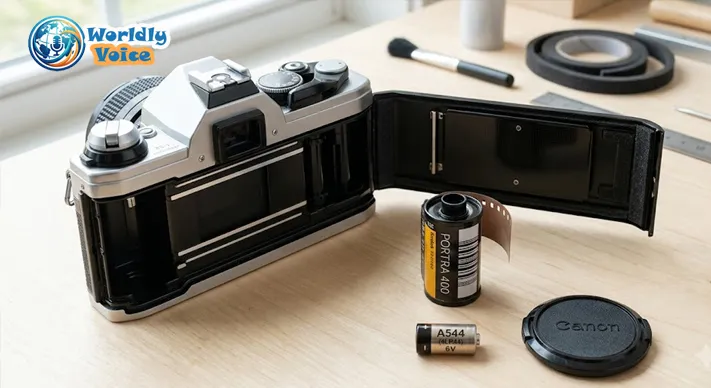
Many beginners search for how to load film in Canon AE-1 Program, and I understand why. Loading film looks intimidating the first time, but the process is simple once you do it slowly.
Here is the basic method:
- Pull up the rewind knob to open the back.
- Place the film canister into the left chamber.
- Push the rewind knob back down.
- Pull the film leader across to the take-up spool.
- Insert the film leader into a slot on the spool.
- Advance the lever gently and confirm the sprockets catch the film.
- Close the back.
- Advance and fire until the frame counter reaches “1.”
Watch the rewind knob as you advance. If it turns, the film is moving correctly.
This small habit prevents one of the most painful beginner mistakes: shooting an entire roll that never advanced.
For original operating details, the Canon AE-1 Program manual is a useful reference.
🧠 7. Is the Canon AE-1 Program Good for Beginners?
Yes, with one condition: beginners must be willing to learn manual focus.
The AE-1 Program handles exposure beautifully in Program mode, but it does not autofocus. You still turn the focusing ring yourself and confirm focus through the viewfinder.
I consider that a benefit. Manual focus slows you down in a useful way. You begin to notice distance, light, backgrounds, and timing.
This is why the AE-1 Program remains one of the best vintage film cameras for beginners. It offers structure without making every decision for you.
It is also easier to recommend than many obscure film bodies because parts, lenses, batteries, and repair knowledge are widely available. Most film camera technicians know the Canon A-series well.
FAQs About the Canon AE-1 Program
Is the Canon AE-1 Program worth buying today?
Yes, if you find one in tested working condition. The Canon AE-1 Program film camera is reliable, easy to learn, and supported by a strong FD lens ecosystem. Avoid untested bodies unless the price is low enough to justify repair risk.
Does the Canon AE-1 Program work without a battery?
No. The shutter is electronically controlled, so the camera needs a working 4LR44 or PX28 6V battery. I always carry a spare 4LR44 battery replacement when shooting.
What film should I use with the Canon AE-1 Program?
For beginners, I recommend Kodak Gold 200, Fujifilm 200, Ilford HP5 Plus, or Kodak Tri-X 400. ISO 200 is nice for daylight. ISO 400 is better for mixed light and indoor scenes.
Are modern Canon lenses compatible?
No, not natively. The AE-1 Program uses Canon FD lenses. Modern Canon EF and RF lenses are not designed for this camera.
What is the Canon cough?
The Canon cough is a squeak or screech caused by dried lubrication in the mirror mechanism. It is common in aging A-series bodies and usually requires professional servicing.
Is this better than other beginner film cameras?
It depends on your needs. Compared with fully manual bodies, the canon ae 1 program is easier for beginners. Compared with later autofocus point-and-shoot cameras, it offers more creative control. If you enjoy researching gear like EverDrive 64 or practical audio reviews such as Monoprice 110010 Review, you will likely appreciate the AE-1 Program’s balance of usability and enthusiast appeal.
Conclusion: Is the Canon AE-1 Program Worth It Today?
The Canon AE-1 Program is still worth buying today, especially for photographers who want a forgiving entry into 35mm film. It is not the most premium vintage SLR. It is not fully mechanical. It needs a battery, and many examples now require maintenance.
But it gets the important things right.
It is comfortable, widely available, simple to operate, and backed by excellent Canon FD lenses. Program mode helps beginners build confidence, while manual and shutter-priority modes leave room to grow.
In my experience, the Canon AE-1 Program film camera works best for people who want to enjoy film without turning every exposure into a technical exam. It invites you to slow down, focus carefully, and pay attention to light.
That is still a beautiful way to make photographs.
If you are buying one, choose condition over cosmetics, budget for a fresh battery, check the light seals, and start with a 50mm lens. Then load a roll and shoot. Like choosing dependable everyday tech such as TWS Earbuds, the best vintage camera is the one you actually enjoy using.
References
- Canon Camera Museum: Canon film camera history
- Canon AE-1 Program manual archive by Butkus
- Canon FD lens mount overview and compatibility information

Job Title: Founder, Chief Editor & Senior Technical SEO Specialist
Institutional Affiliation: Jullypoco Digital Properties
Specialties: Technical Search Engine Optimization | Content Strategy & Publishing | Web Architecture
Muhammad Ali is a seasoned digital content strategist, technical SEO professional, and the founder of Jullypoco. With deep expertise in website management, domain optimization, and search architecture, he orchestrates high-impact editorial frameworks designed to connect global audiences with reliable, high-value information. His commitment to search integrity and evidence-based optimization ensures the highest standards of data accuracy and site performance.
Verify Credentials & Connect:
🌐 Official Jullypoco Author Hub |
💼 LinkedIn Professional Profile |
👥 Facebook Profile