



Car airbags are easy to forget until the worst moment happens. Then, in a fraction of a second, they become one of the most important safety systems in your vehicle. Many drivers know airbags save lives. Fewer understand how do car airbags work, why car airbags deployed only in certain crashes, or when were car airbags invented in the first place.
That gap matters. Misunderstanding airbags can lead to unsafe habits, especially for children, unbelted passengers, or drivers who ignore dashboard warning lights. Airbags are not magic cushions. They are carefully engineered safety devices designed to reduce injury during serious impacts. They work best with seat belts, smart sensors, and modern crash algorithms.
In this guide, we will break down seven essential facts about airbags in simple terms. You will learn how they function, when they deploy, what types exist today, and why they continue to evolve. If you have ever wondered whether airbags are enough on their own, or whether modern systems are safer than older ones, this article will give you clear answers.
1. Car Airbags Are Supplemental Safety Systems, Not Seat Belt Replacements
The first thing to understand is simple: airbags are part of a Supplemental Restraint System (SRS). The word “supplemental” is crucial. It means airbags are designed to support seat belts, not replace them.
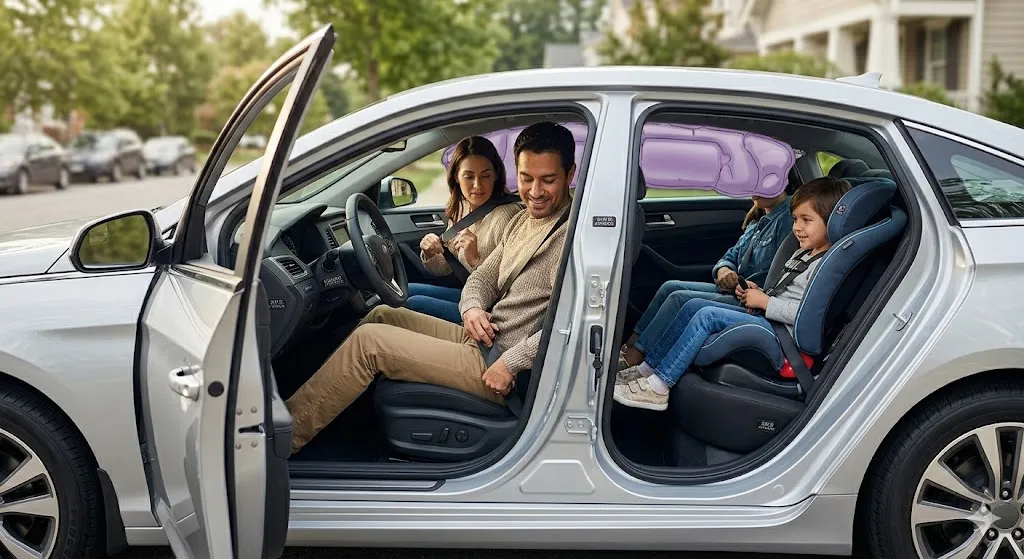
When a crash happens, a seat belt helps keep your body in position. The airbag then cushions the impact between you and hard interior surfaces, such as:
- The steering wheel
- Dashboard
- Side door
- Window glass
- Pillars inside the cabin
Without a seat belt, the body can move too far forward before the airbag inflates. That can increase the risk of injury rather than reduce it.
A simple way to picture it: a seat belt is like a catcher’s glove guiding the motion, while the airbag is the padded wall softening the blow.
Real-world crash data has consistently shown that the combination of seat belts and airbags offers better protection than either system alone. According to the NHTSA airbags, frontal airbags have helped save thousands of lives in moderate to severe crashes.
Why this matters in everyday driving
Many people assume airbags will protect them even if they sit too close to the steering wheel or ride unbelted for a short trip. That is a dangerous myth.
For safer airbag performance:
- Wear your seat belt every trip
- Sit at least 10 inches from the steering wheel if possible
- Keep both hands positioned safely on the wheel
- Make sure children ride in the back seat
2. How Do Car Airbags Work? The Process Happens in Milliseconds
If you have ever asked, how do car airbags work, the answer is both technical and surprisingly elegant. The whole system depends on speed, timing, and precision.
Inside the car, sensors monitor sudden deceleration and impact forces. These sensors send data to the vehicle’s electronic control unit, often called the ECU. If the ECU detects a crash serious enough to require protection, it triggers the inflator.
The inflator creates gas almost instantly, filling the airbag in milliseconds. The bag bursts from its housing before the occupant strikes the interior. Just as quickly, it begins to deflate through tiny vents. That deflation is important. It absorbs energy and prevents the person from bouncing back too hard.
The deployment chain usually looks like this:
- Sensors detect a severe impact
- The ECU analyzes speed, angle, and force
- The inflator activates
- Gas fills the airbag
- The occupant contacts the inflated bag
- The bag vents and deflates
Older systems relied on chemical reactions that produced gas rapidly. Newer designs are more refined and often use improved inflators and multi-stage deployment logic.
Why milliseconds matter
A serious crash unfolds faster than human reaction time. In many cases, the airbag must deploy in about 20 to 50 milliseconds. That is faster than the blink of an eye.
This speed is why car airbags deployed can leave behind powder, noise, and brief smoke. Those effects are normal in many cases. They are part of a violent but controlled safety event.
3. When Were Car Airbags Invented? Their History Goes Back Decades
The answer to when were car airbags invented surprises many people. The idea is not new. Early concepts appeared in the 1950s, when inventors began exploring inflatable crash protection for vehicles.
Still, invention and widespread use were not the same thing.
A quick timeline of airbag development
| Period | What Happened | Why It Mattered |
|---|---|---|
| 1950s | Early airbag patents were filed | The core idea of inflatable crash protection emerged |
| 1970s | Some production vehicles introduced airbags | Automakers began testing real-world application |
| 1980s | More manufacturers adopted driver airbags | Safety systems became more practical and accepted |
| 1990s | Dual airbags and improved crash sensing expanded | Airbags became common in many passenger vehicles |
| 2000s | Side, curtain, and knee airbags spread widely | Occupant protection improved beyond frontal crashes |
| 2010s onward | Adaptive and smart airbags advanced | Systems became more precise for different occupants |
Early airbags had limitations. They were more forceful and less intelligent than today’s versions. That led to safety concerns, especially for small adults and children seated too close to the dashboard.
Modern airbags are much smarter. They can account for crash severity, seat position, passenger weight, and even whether someone is wearing a belt.
This evolution matters because the question is no longer just when were car airbags invented. It is how well they perform now compared with earlier generations. The answer is clear: dramatically better.
4. Car Airbags Deployed Only Under Specific Crash Conditions
One of the biggest misconceptions is that airbags deploy in every collision. They do not.
In reality, car airbags deployed only when crash conditions meet specific thresholds programmed into the vehicle’s safety system. These thresholds vary by manufacturer, vehicle design, and impact type.
Common factors that affect deployment
- Crash angle: Front airbags often respond to impacts within a limited frontal zone
- Impact severity: A low-speed bump may not trigger deployment
- Type of object hit: A rigid wall can cause deployment more easily than a brush with a flexible object
- Seat belt use and occupancy data: Some systems adjust response based on who is seated and how
- Vehicle speed change: Sudden deceleration is a major trigger
For example, a crumpled fender after sliding into a pole may not always mean the airbags should have gone off. On the other hand, a stronger frontal collision with a rigid barrier may trigger them immediately.
Why airbags sometimes do not deploy
This is often misunderstood after accidents. No deployment does not automatically mean a defect.
Airbags may stay inactive because:
- The impact was below the deployment threshold
- The collision happened at an angle outside sensor criteria
- The crash energy was absorbed elsewhere
- It was a rear-end collision, where frontal airbags may not help
- A sensor or SRS system fault existed
If you ever see an SRS or airbag warning light, treat it seriously. The IIHS airbags information explains how airbag design depends heavily on crash type and occupant position.
A practical example
Imagine two different crashes at similar speeds. In one, the car hits a solid concrete barrier head-on. In the other, it sideswipes a guardrail. The first may trigger frontal airbags. The second may not, because the forces affecting the occupants are different.
5. There Are Many Types of Car Airbags Today
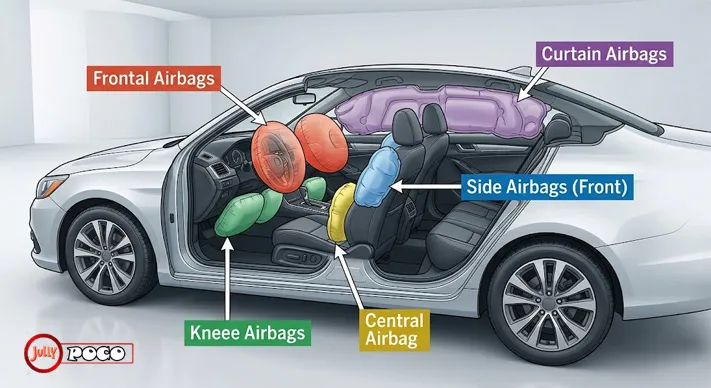
Most people think of the steering wheel airbag first. But modern vehicles can include several types of airbags, each designed for a specific protection zone.
Main types of airbags in modern vehicles
Frontal airbags
These protect the driver and front passenger in head-on or near-frontal crashes. They are still the most recognized form of protection.
Side airbags
Usually mounted in the seat or door area, these help protect the chest and torso during side impacts.
Curtain airbags
These drop down from above the windows and protect the head. They also help reduce contact with shattered glass.
Knee airbags
These are designed to reduce leg movement and lower-body injuries. They also help keep the occupant aligned during impact.
Central airbags
These newer airbags help prevent front-seat occupants from colliding with each other during side crashes.
Pedestrian airbags
Some advanced vehicles include external airbags that deploy near the hood or windshield area to reduce injury to pedestrians.
These systems reflect how far vehicle safety has progressed. Airbags no longer focus only on one kind of crash. They now address side impacts, rollovers, occupant movement, and even people outside the car.
6. Modern Airbags Are Smarter, More Adaptive, and More Personalized
Today’s car airbags do much more than inflate with one fixed force. Many systems are adaptive. That means they change deployment based on crash severity and occupant data.
What modern innovation looks like
- Dual-stage or multi-stage deployment: The bag can inflate with different force levels
- Occupant classification systems: Sensors estimate passenger size and weight
- Seat position awareness: The system considers how close the person is to the airbag
- Crash severity analysis: More forceful crashes may require stronger deployment
- Integration with driver-assistance systems: Some vehicles prepare safety systems before impact
This matters for both comfort and survival. A smaller adult in a lower-speed crash may need a gentler response than a larger adult in a high-energy collision.
Some manufacturers are also exploring:
- Biometric sensing
- Better rollover protection
- Safer airbag shapes for new seating layouts
- Eco-friendlier materials and inflator designs
As autonomous features grow, airbags may need to protect occupants in less traditional seating positions. That challenge is already shaping future design.
7. Airbags Save Lives, but They Also Have Limits and Responsibilities
Airbags are life-saving devices, but they are not risk-free. Like every safety tool, they have limits. Understanding those limits is part of using them safely.
Key safety truths every driver should know
Airbags are one-time devices
Once car airbags deployed, they must be replaced. The system, sensors, trim parts, and modules may also need inspection or repair.
Children need extra caution
Children under 12 are generally safer in the rear seat. A front airbag can injure a child, especially in a rear-facing child seat.
Warning lights should never be ignored
If the SRS warning light stays on, the airbag system may not work correctly in a crash.
Recalls matter
The Takata airbag crisis showed the world that defective inflators can become deadly. Always check recalls and complete repairs promptly.
Airbags do not prevent every injury
They reduce risk. They do not erase crash forces. Serious collisions can still cause trauma, even with the best protection systems.
Insurance and repair implications
After airbags deploy, repair costs often rise sharply. Why? Because replacement may involve:
- Airbag modules
- Sensors
- Seat belt pretensioners
- Dashboard or steering wheel components
- Wiring and control units
That is one reason insurers sometimes declare older vehicles a total loss after airbag deployment. The damage is not just cosmetic. It affects the heart of the safety system.
A human reminder
Many survivors describe airbags as violent but life-saving. They remember the explosion, the powder, and the shock. They also remember walking away. That is the point. Airbags are not designed to feel gentle. They are designed to interrupt injury in the briefest, harshest moment.
FAQs About Car Airbags
1. Do airbags deploy in every crash?
No. Airbags deploy only when crash sensors detect conditions severe enough to justify activation.
2. Can airbags work without seat belts?
They can deploy, but they work best with seat belts. Without a belt, injury risk is much higher.
3. Are airbags dangerous for children?
They can be. Children under 12 should usually ride in the back seat, properly restrained.
4. What should I do after airbags deploy?
Do not drive the vehicle until it is inspected. The airbag system must be repaired and reset professionally.
5. Why is there dust or smoke after deployment?
That is often normal. It can come from the inflator process and airbag materials during rapid deployment.
6. How can I tell if my airbag system has a problem?
Look for an illuminated SRS or airbag warning light. Have it checked as soon as possible.
Final Thoughts
Car airbags have changed road safety in a profound way. They are fast, intelligent, and increasingly precise. Yet their biggest strength is not technology alone. It is the way they work together with seat belts, sensors, and safe driving habits.
If you remember one thing, let it be this: airbags are there for the moment you cannot control. But their success depends on what you do before that moment arrives. Wear your seat belt. Seat children correctly. Pay attention to warning lights. Check recalls. Understand when car airbags deployed and why that event always deserves serious follow-up.
If you are shopping for a car, do not count airbags. Ask how they work, where they are placed, and what smart features support them. That is where modern safety really begins.
References
- National Highway Traffic Safety Administration: NHTSA airbags
- Insurance Institute for Highway Safety: IIHS airbags


Job Title: Founder, Chief Editor & Senior Technical SEO Specialist
Institutional Affiliation: Jullypoco Digital Properties
Specialties: Technical Search Engine Optimization | Content Strategy & Publishing | Web Architecture
Muhammad Ali is a seasoned digital content strategist, technical SEO professional, and the founder of Jullypoco. With deep expertise in website management, domain optimization, and search architecture, he orchestrates high-impact editorial frameworks designed to connect global audiences with reliable, high-value information. His commitment to search integrity and evidence-based optimization ensures the highest standards of data accuracy and site performance.
Verify Credentials & Connect:
🌐 Official Jullypoco Author Hub |
💼 LinkedIn Professional Profile |
👥 Facebook Profile
4 Comments
Pingback: Why Is My Steering Wheel Shaking When I Brake? Causes & Fixes
Pingback: How to Get a Driving Licence in Germany: Complete 7-Step Guide
Pingback: Is Brake Checking Illegal? Fault, Penalties & What to Do After an Accident
Pingback: Hyundai Santa Fe vs Palisade: Which SUV Is Best?