



“Why is my steering wheel shaking when I brake?” is one of those questions drivers usually ask after one unsettling moment: you press the brake pedal, the car slows down, and the steering wheel starts trembling in your hands. I’ve felt it myself during a highway slowdown, and it immediately changes your mood from calm to concerned.
A shaking steering wheel during braking is not something to ignore. Sometimes it is a simple tire balance issue. More often, it points to brake pulsation, warped rotors, worn brake pads, misaligned wheels, or suspension wear. If the steering wheel shakes when braking at high speeds, the issue deserves even faster attention because braking stability matters most when speed is involved.
If you are also dealing with dashboard warnings, it may help to review related issues like What does it mean when engine light is blinking, ABS warning light, and brake warning light. Braking problems can overlap with other safety systems, especially in newer vehicles.
Quick Summary: What It Usually Means
A shaking steering wheel when braking is usually caused by warped brake rotors, worn brake pads, or tire and wheel problems. It can also come from faulty calipers, loose suspension parts, wheel bearing wear, or poor alignment.
The safest approach is simple: inspect the brakes first, then tires, alignment, suspension, and steering components.
🚗 Steering Wheel Shaking When Braking: Main Causes
When we talk about steering wheel shaking when braking causes, we are usually talking about parts that rotate, grip, or hold the front wheels steady. Your front brakes do most of the stopping work, so front-end vibration often travels directly into the steering wheel.
In my experience, many drivers replace tires first because the vibration feels like a wheel issue. Sometimes that works. But if the shake only appears when braking, I always start with the brake system.
Here are the most common causes.
1. Warped Brake Rotors: The Most Common Cause
Brake rotors are the round metal discs your brake pads squeeze to slow the vehicle. In a disc brake system, the caliper pushes the pads against the rotor. When the rotor surface is smooth and even, braking feels stable. When the rotor is uneven, the pads grab and release rapidly.
That creates steering wheel vibration.
Many people call this “warped rotors,” although the real issue is often uneven rotor thickness, heat spots, or surface variation. Either way, the result feels the same: the steering wheel shakes, and sometimes the brake pedal pulsates.
Warped Rotors Symptoms
Common warped rotors symptoms include:
- Steering wheel vibration when braking
- Brake pedal pulsates under your foot
- Vibration that gets worse at highway speeds
- A pulsing or grabbing feeling during stops
- Longer stopping distance in some cases
- Uneven brake pad wear
If the steering wheel vibrates when braking hard, warped front rotors are one of the first things I would inspect. Hard braking creates heat. Repeated heat cycles can damage rotor surfaces, especially if the rotors are already thin or poor quality.
According to the National Highway Traffic Safety Administration, brake performance is a major part of vehicle safety, and drivers should not delay inspections when braking feels abnormal. You can review their safety guidance on brake fluid level and braking system awareness.
How to Fix Warped Rotors
A mechanic may recommend:
- Rotor resurfacing if the rotor is still thick enough
- Rotor replacement if it is too thin, cracked, or badly scored
- New brake pads with rotor service
- Caliper inspection to ensure even pressure
I rarely suggest replacing only the pads if the rotor surface is uneven. New pads on damaged rotors can wear quickly and bring the vibration back.
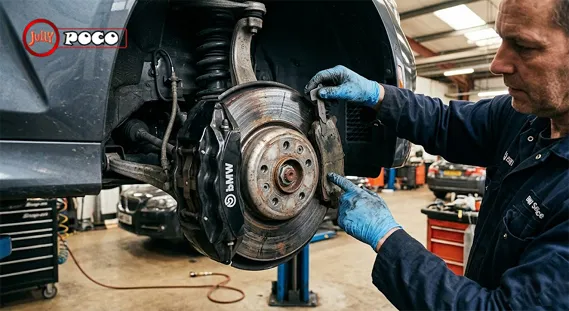
2. Worn or Contaminated Brake Pads
Brake pads are designed to grip the rotor evenly. When they wear down, glaze over, crack, or collect dirt and grease, they no longer bite smoothly.
That uneven contact can create vibration through the steering column.
You may also notice:
- Squealing or grinding noises
- Reduced braking power
- A burning smell after repeated braking
- Brake dust buildup
- The car taking longer to stop
In one case I inspected, a driver complained that the front end shakes when braking after driving through hilly roads. The pads were badly glazed from heat. The rotors had light scoring too. Replacing pads alone would not have fixed the problem for long, so the shop serviced both pads and rotors.
How to Fix Bad Brake Pads
The fix is usually straightforward:
- Replace worn pads in axle pairs
- Inspect rotors for scoring or thickness variation
- Clean and lubricate caliper slide pins
- Check brake hardware clips
- Flush old brake fluid if needed
Brake pads are cheaper than rotors and calipers. Replacing them on time helps prevent more expensive damage.
3. Tire and Wheel Problems
Not every braking vibration starts with the brakes. Tires and wheels can also cause shaking, especially if the vibration appears at certain speeds.
If the steering wheel shakes on the highway even before braking, then gets worse when you brake, tire balance or wheel damage may be involved.
Common tire and wheel causes include:
- Out-of-balance tires
- Bent wheels
- Uneven tire wear
- Low tire pressure
- Damaged tire belts
- Poor tire rotation habits
The NHTSA explains that correct tire pressure is important for safe handling, braking, and tire life. I’ve seen underinflated tires make a mild brake vibration feel much worse because the tire cannot maintain stable road contact.
This is also where related topics like tire pressure light, wheel alignment symptoms, and uneven tire wear causes become useful. Tire and brake symptoms often overlap.
When Tires Are the Likely Cause
Tires may be the main problem if:
- Shaking happens even when not braking
- Vibration changes with road speed
- The steering wheel wobbles around 80–120 km/h
- You recently hit a pothole
- One tire shows cupping or bulging
In Pakistan, road conditions can make this worse. Potholes, uneven surfaces, broken road edges, and sudden speed breakers can bend rims, disturb alignment, or damage suspension parts. I’ve noticed this especially on smaller cars like the Suzuki Alto, Toyota Corolla, and Honda Civic, where repeated impacts can show up as front-end vibration.
How to Fix Tire and Wheel Issues
A tire shop can perform:
- Wheel balancing
- Tire rotation
- Rim inspection
- Tire pressure correction
- Tire replacement if damaged
- Road-force balancing for stubborn vibration
If the steering wheel shakes when braking at high speeds, I would check both the front rotors and front wheel balance before replacing parts blindly.
4. Wheel Alignment Problems
Wheel alignment controls how the tires meet the road. If alignment is off, the car may pull left or right, the tires may wear unevenly, and braking can feel unstable.
Misalignment does not usually create brake pulsation by itself. But it can make existing brake or tire vibration feel stronger.
Signs of Bad Alignment
Look for:
- Car pulling to one side
- Crooked steering wheel
- Uneven tire wear
- Wandering at highway speeds
- Steering vibration after hitting a pothole
A proper alignment check is not just about comfort. It protects tires, improves fuel economy, and helps the vehicle brake in a straight line.
How to Fix Alignment Issues
Ask for a professional wheel alignment. The technician should inspect:
- Toe angle
- Camber angle
- Caster angle
- Tie rods
- Control arms
- Ball joints
If suspension parts are loose, alignment alone will not hold. The worn parts must be repaired first.
5. Stuck or Faulty Brake Calipers
Brake calipers squeeze the pads against the rotors. If a caliper sticks, it may keep pressure on one side or apply uneven force during braking.
This can cause vibration, pulling, heat, and rapid pad wear.
Symptoms of a Sticking Caliper
You may notice:
- Car pulls to one side when braking
- One wheel feels hotter than the others
- Burning smell near a wheel
- Uneven brake pad wear
- Reduced fuel economy
- Shaking during braking
A stuck caliper can also overheat the rotor. That heat can create rotor thickness variation, which then causes brake pedal pulsation and steering shake.
How to Fix Caliper Problems
Depending on the condition, a shop may:
- Clean and lubricate slide pins
- Replace caliper hardware
- Replace the caliper
- Flush contaminated brake fluid
- Replace pads and rotors if heat-damaged
Do not ignore caliper issues. A dragging caliper can damage multiple parts quickly.
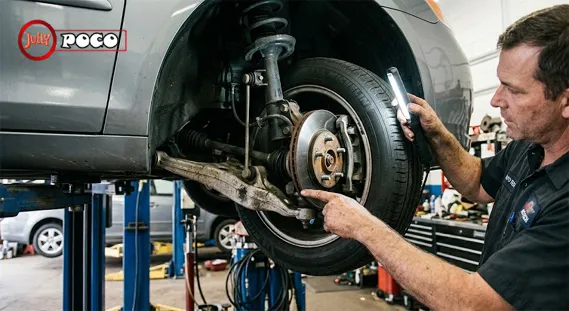
6. Suspension Issues: When the Front End Shakes When Braking
If the front end shakes when braking, suspension wear is another strong possibility. Your suspension holds the tires steady against the road. When parts are loose, braking force can make the front wheels move or flutter.
Important parts include:
- Control arms
- Ball joints
- Tie rods
- Shocks and struts
- Bushings
- Wheel bearings
When these parts wear out, the car may feel unstable even if the brakes are new.
For example, I once saw a car with fresh rotors and pads still shaking during stops. The real issue was a worn lower control arm bushing. Under braking, the wheel shifted backward slightly, sending vibration into the steering wheel.
Suspension Warning Signs
Watch for:
- Clunking over bumps
- Loose steering feel
- Uneven tire wear
- Nose diving during braking
- Vibration on rough roads
- Steering wander
This connects closely with topics like car suspension problems, steering rack symptoms, and Car Airbags, because vehicle stability affects crash safety systems too.
Quick Comparison: Causes, Symptoms, and Fixes
| Cause | Common Symptoms | Best Fix |
|---|---|---|
| Warped brake rotors | Vibration only when braking, brake pedal pulsates | Resurface or replace rotors |
| Worn brake pads | Noise, reduced braking, steering wheel vibration | Replace pads and inspect rotors |
| Unbalanced tires | Shaking at high speeds, vibration with or without braking | Balance or replace tires |
| Bent wheel | Wobble after pothole impact | Repair or replace rim |
| Misalignment | Pulling, crooked steering wheel, uneven tire wear | Professional wheel alignment |
| Stuck caliper | Car pulls, hot wheel, uneven pad wear | Repair or replace caliper |
| Suspension wear | Front-end shake, clunks, unstable handling | Replace worn components |
| Wheel bearing wear | Humming noise, looseness, vibration | Replace bearing/hub assembly |
How to Fix a Shaking Steering Wheel When Braking
If you are wondering how to fix a shaking steering wheel when braking, start with diagnosis, not guesswork. Replacing random parts gets expensive fast.
Here is the order I recommend.
Step 1: Notice When the Vibration Happens
Ask yourself:
- Does it shake only when braking?
- Does it shake at high speeds without braking?
- Does the brake pedal pulsate?
- Does the car pull to one side?
- Did it start after a pothole or tire change?
If shaking only appears while braking, brakes are the first suspect. If shaking happens all the time at speed, tires and wheels move higher on the list.
Step 2: Inspect the Front Brakes
The front brakes handle most braking force. A technician should check:
- Rotor runout
- Rotor thickness
- Pad thickness
- Pad wear pattern
- Caliper slide movement
- Brake hose condition
- Brake fluid condition
Modern vehicles with ABS and electronic stability control can sometimes mask early brake problems. You may not feel small issues until they become more noticeable. That is why routine inspection matters.
For a basic explanation of disc brakes, Britannica provides a helpful overview of how rotor-and-caliper systems work.
Step 3: Check Tires and Wheels
Ask for:
- Tire balancing
- Tire pressure check
- Rim inspection
- Tire tread inspection
- Rotation pattern review
If the steering wheel vibration changes after rotating tires, you may have a tire or wheel problem.
Step 4: Perform Alignment and Suspension Checks
A good shop should inspect suspension before alignment. Aligning a car with loose parts is like adjusting a door with broken hinges. It may look right briefly, but it will not stay right.
Step 5: Do Not Ignore Brake Fluid
Low or contaminated brake fluid can affect braking feel. It may not be the most common cause of steering wheel shake, but it matters for safety. If the pedal feels soft, sinks, or braking feels inconsistent, stop driving and have the system inspected.
Real-World Example: Highway Shaking After a Pothole
A driver brought in a sedan after the steering wheel started shaking during highway braking. He assumed the rotors were warped. The brake pedal did pulsate slightly, so that seemed logical.
But the inspection found two issues: a slightly bent front rim and uneven rotor wear. The pothole impact likely damaged the wheel and disturbed the alignment. The uneven braking then became more obvious at higher speeds.
The fix was not one part. It required wheel repair, balancing, alignment, and front rotor replacement. After that, the car braked smoothly again.
That is why proper diagnosis matters.
When Is It Unsafe to Keep Driving?
Do not keep driving if:
- The steering wheel shakes violently
- The brake pedal sinks to the floor
- The car pulls hard while braking
- You hear grinding metal sounds
- Smoke or burning smell comes from a wheel
- A brake warning light appears
- The vehicle feels unstable at speed
If the vibration is mild, drive slowly to a trusted mechanic. If braking feels unsafe, stop and arrange towing.
Maintenance Tips to Prevent Brake Vibration
A few habits can reduce the chance of brake pulsation and steering shake.
- Inspect brakes every 10,000–15,000 km
- Rotate and balance tires regularly
- Keep tire pressure correct
- Avoid repeated hard braking when possible
- Do not ride the brakes downhill
- Replace pads before they grind into rotors
- Get alignment checked after major pothole hits
- Use quality parts from trusted brands
In my experience, drivers who service tires and brakes together have fewer recurring vibration complaints. The systems work as a team.
FAQs
1. Why does my steering wheel shake only when I brake?
If it shakes only during braking, the most likely cause is uneven front brake rotors. Worn pads, stuck calipers, or loose suspension parts can also cause it.
2. Can bad tires cause steering wheel vibration when braking?
Yes. Bad tires, unbalanced wheels, or bent rims can make braking vibration worse. If shaking also happens when you are not braking, inspect tires and wheels first.
3. Is it safe to drive if the steering wheel vibrates when braking hard?
A mild vibration may allow a short drive to a repair shop. But if the steering wheel vibrates when braking hard or the car pulls, avoid highway driving and get it checked quickly.
4. How much does it cost to fix a shaking steering wheel?
It depends on the cause. Tire balancing is usually cheaper than rotor or suspension replacement. A full brake job with rotors and pads costs more, but delaying it can damage calipers.
5. Can ABS cause steering wheel shaking?
ABS can cause pedal pulsing during emergency braking, which is normal. But regular steering wheel shaking during normal stops usually points to rotors, tires, alignment, or suspension issues.
6. Should I replace rotors or resurface them?
Resurfacing works only if the rotors are thick enough and not badly damaged. Many modern rotors are thin, so replacement is often the better long-term fix.
Conclusion
If you are asking, “Why is my steering wheel shaking when I brake?” the answer usually starts with the front brakes. Warped rotors, worn pads, and brake pulsation are common. But tires, alignment, calipers, bearings, and suspension parts can create similar symptoms.
The key is to act early. A small vibration can turn into expensive rotor, tire, or suspension damage if ignored.
Start with a brake inspection. Then check tires, alignment, and front-end components. If you also notice warning lights, review related safety topics like What does it mean when engine light is blinking, Car Airbags, ABS warning light, and brake warning light.
Smooth braking is not just about comfort. It is about control, safety, and confidence every time you slow down.
References and Further Reading
- National Highway Traffic Safety Administration: Brake and vehicle safety guidance
- National Highway Traffic Safety Administration: Tire safety and inflation guidance
- Encyclopaedia Britannica: Disc brake system overview

Job Title: Founder, Chief Editor & Senior Technical SEO Specialist
Institutional Affiliation: Jullypoco Digital Properties
Specialties: Technical Search Engine Optimization | Content Strategy & Publishing | Web Architecture
Muhammad Ali is a seasoned digital content strategist, technical SEO professional, and the founder of Jullypoco. With deep expertise in website management, domain optimization, and search architecture, he orchestrates high-impact editorial frameworks designed to connect global audiences with reliable, high-value information. His commitment to search integrity and evidence-based optimization ensures the highest standards of data accuracy and site performance.
Verify Credentials & Connect:
🌐 Official Jullypoco Author Hub |
💼 LinkedIn Professional Profile |
👥 Facebook Profile
2 Comments
Pingback: Chevy Silverado Trucks Brake Defect Recall: Affected Models, Risks & Free Repairs
Pingback: Is Brake Checking Illegal? Fault, Penalties & What to Do After an Accident