



If you’re exploring Amazon Business in Germany, you’re looking at the biggest e-commerce gateway in Europe’s largest online retail market. I’ve worked with cross-border sellers and procurement teams long enough to see one pattern repeat: Germany rewards preparation. Sellers who understand VAT, logistics, language, and B2B buying behavior usually scale faster. Those who treat Germany like “just another Amazon marketplace” often hit avoidable friction.
In 2026, that gap matters even more. Amazon.de remains the dominant marketplace in Germany, while Amazon continues investing billions into logistics, cloud infrastructure, and sustainability. For brands, wholesalers, and procurement leaders, this creates a rare overlap: enormous consumer demand, mature corporate procurement infrastructure, and reliable cross-border e-commerce logistics.
If you’re building a German market expansion strategy, this guide will walk you through what actually matters. I’ll cover registration, taxes, FBA, B2B tools, metrics, and what foreign sellers need to know if they want to sell on amazon germany from us or other non-EU markets.
If you’re still setting up your financial back office, I’d also pair this with How to Open a Freelance Bank Account in Germany, especially if you want cleaner bookkeeping from day one.
1. Why Amazon.de still dominates Germany in 2026
Germany is not a niche opportunity. It is the largest e-commerce market in Europe, with annual online retail value above €100 billion by most industry estimates. Amazon.de consistently ranks among the most visited websites in the country and remains the top marketplace for both B2C shopping and a growing share of B2B purchasing.
What stands out to me is not just traffic volume. It’s buyer intent.
German customers tend to compare carefully, read reviews closely, and expect precise product information. Business buyers do the same, just at a larger scale. That makes Amazon’s ecosystem especially effective because it combines:
- Strong search visibility
- Prime-backed delivery expectations
- Familiar checkout and invoicing
- Broad trust among consumers and companies
- Expanding pan-European fulfillment networks
Amazon has also committed major investment into Germany through logistics sites, AWS infrastructure, and renewable energy projects. That matters because stronger infrastructure usually means faster fulfillment, more reliable storage, and better support for enterprise purchasing.
For sellers, this is not just a retail story. It’s a platform story. And for procurement teams, it’s increasingly a workflow story.
2. Who should consider Amazon Business in Germany?
In my experience, Amazon Germany works best for four groups:
1. Established brands entering Europe
If you already sell in the US, UK, or other EU markets, Germany is often the next logical move. The demand is there, and Amazon.de can serve as your main launchpad.
2. US sellers testing cross-border demand
Many founders ask whether they can sell on amazon germany from us without opening a German company. In many cases, yes. You can register remotely, but you still need to manage VAT, product compliance, and customer service expectations correctly.
3. B2B distributors and wholesalers
This is where Amazon Business in Germany becomes especially interesting. Amazon Business supports business-only pricing, invoice workflows, quantity discounts, and procurement integrations that make the platform relevant beyond standard retail.
4. Procurement leaders and SMB buyers
For buyers, Amazon Business Germany simplifies sourcing, approval controls, and repeat ordering. It can fit neatly into a broader digital merc and procurement stack, especially when speed and supplier diversity matter.
If you’re comparing operational software before scaling, articles like Best Jobber Alternatives for Small Business and expense tracking tools for freelancers in Germany can help tighten the operational side behind your Amazon activity.
3. Seller registration: what you need before launch
Getting started is straightforward on paper. But details matter.
To open a seller account, you generally need:
- Government-issued ID
- Credit card
- Bank account
- Business information
- Tax details, including VAT where required
You do not always need a German GmbH. A sole proprietor or foreign business can often register and start selling, depending on structure and compliance readiness.
Inside amazon business de seller central, you’ll manage:
- Product listings
- Inventory
- Orders and returns
- Advertising
- Tax invoicing settings
- Business pricing
- Reports and analytics
I always tell sellers to treat setup as a compliance project, not just an onboarding form. The marketplace is easy to enter. Staying healthy on the marketplace is where the real work begins.
Seller account options at a glance
| Feature | Individual Plan | Professional Plan |
|---|---|---|
| Monthly fee | €0 | €39/month |
| Per-item fee | €0.99/item sold | No per-item fee |
| Best for | Very low-volume sellers | Growing brands and serious sellers |
| Access to advanced tools | Limited | Full access |
| Advertising and scaling potential | Lower | Higher |
For most businesses, the Professional plan is the practical choice.
4. VAT and compliance: where sellers usually make mistakes
This is the part people underestimate.
Any serious fba germany compliance guide should start with one truth: VAT is not optional if your selling model triggers it. If you store goods in Germany, you usually need German VAT registration. If you use Pan-European FBA and stock inventory in multiple EU countries, you may need VAT registration in each relevant storage country.
That often includes:
- Germany
- Poland
- Czech Republic
- France
- Italy
- Spain
- Netherlands, depending on your setup
You may also need:
- Steuernummer
- USt-IdNr. (VAT ID)
- Proper VAT invoices
- OSS registration for eligible EU distance sales
This is where Value-Added Tax (VAT) automation becomes more than a convenience. It becomes risk control.
In my experience, sellers who automate tax workflows early spend less time untangling invoice errors later. Amazon provides some invoicing support, but you still need your own tax strategy. Do not assume the platform handles everything.
You also need product-level compliance. Common requirements include:
- Correct EAN/GTIN data
- ASIN and SKU mapping
- FNSKU labeling for FBA
- Product authenticity documentation
- Safety, packaging, and restricted-category checks
For foreign operators planning to sell on amazon germany from us, product compliance can be just as important as tax compliance. A listing can fail because of labeling, manuals, certifications, or category-specific rules.
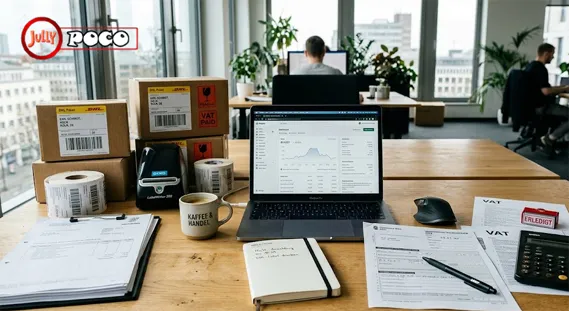
5. FBA vs FBM: choosing the right logistics model
The logistics decision shapes your margins, customer experience, and compliance burden.
Fulfillment by Amazon (FBA)
With FBA, Amazon stores, picks, packs, ships, and often handles part of customer service. This usually improves delivery speed and Prime visibility.
Benefits include:
- Prime eligibility
- Better conversion rates
- Faster shipping
- Easier scaling
- Stronger support for cross-border e-commerce logistics
For many brands, FBA is the simplest route into Amazon Business in Germany because it aligns with buyer expectations.
Fulfillment by Merchant (FBM)
With FBM, you handle your own warehousing and delivery. This model can work well for:
- Oversized products
- Low-margin items
- Custom or made-to-order inventory
- Brands with strong 3PL relationships
Pan-European FBA
This is attractive if you want broad EU reach and faster regional delivery. Amazon distributes stock across its network, reducing last-mile friction. But this also expands tax and reporting obligations.
A practical fba germany compliance guide should always weigh convenience against VAT complexity. Faster delivery can increase sales, but it may also increase filing obligations across multiple countries.
6. B2B growth: what Amazon Business Germany adds beyond retail
This is one of the most overlooked opportunities.
Amazon Business is not just Amazon with a business badge. It includes features tailored for professional buyers and procurement teams. That includes:
- Business pricing
- Quantity discounts
- VAT-ready invoicing
- Approval workflows
- Purchasing analytics
- Multi-user business accounts
- Integration support for enterprise buying systems
For sellers, this opens a different revenue lane. A product that struggles in consumer retail can perform well in business procurement if it solves a workplace need: safety supplies, office equipment, MRO items, packaging, electronics accessories, cleaning products, and bulk consumables.
Inside amazon business de seller central, these tools help you position products for business customers rather than only consumers.
Why B2B margins can be more stable
In my experience, B2B buyers often care less about brand storytelling and more about availability, invoice clarity, consistency, and reorder confidence. That means operational discipline matters more than flashy listing language.
Tracking performance with B2B data
If you want to grow this channel, pay attention to amazon b2b metrics germany. These metrics can help you understand:
- Business order share
- Average business basket size
- Repeat purchase behavior
- Buyer engagement with quantity discounts
- Conversion trends by account type
I’ve found that looking at B2B and B2C performance separately often reveals missed opportunities. A listing may look average overall but be highly efficient with business buyers.
7. Fees, incentives, and realistic budgeting
Before launch, build your economics clearly.
Typical cost layers include:
- Monthly seller subscription
- Referral fees by category
- FBA fulfillment fees
- Storage fees
- Returns costs
- Advertising spend
- VAT compliance and bookkeeping
- Translation or localization support
Amazon has also offered incentives for new sellers, including credits for ads, coupons, and review-generation tools like Vine. These offers change over time, so verify current terms before relying on them.
What I usually recommend is a “Germany launch budget” with three buckets:
- Compliance and setup
- Inventory and logistics
- Ads and listing localization
That structure prevents a common mistake: spending heavily on ads before the account, VAT, and content stack are stable.
If you need stronger finance systems around your marketplace growth, small business bookkeeping tips in Germany and best invoicing software for freelancers in Germany are useful related reads.
8. Language, localization, and trust: the hidden conversion factor
This deserves more attention than it gets.
Yes, many Germans understand English. No, that does not mean your English-language listing will perform well enough.
I’ve seen sellers with solid products underperform simply because their listings sounded translated, vague, or culturally off. German buyers usually respond well to:
- Clear product titles
- Specific dimensions and technical specs
- Practical benefit statements
- Well-structured bullet points
- Accurate customer support responses
For B2B buyers, this matters even more. Procurement teams want fewer surprises. If your invoice language, listing details, or post-purchase communication create friction, trust drops quickly.
So if you plan to sell on amazon germany from us, invest in native-level localization. It protects both conversion rate and seller health.
9. Seasonality, sustainability, and planning for 2026
The German market has strong seasonal patterns. December usually brings peak demand, while February often slows. Inventory planning should reflect that. I’ve seen sellers overstock after holiday momentum, then absorb unnecessary storage costs in Q1.
Sustainability is another real factor. Amazon’s investments in renewable energy and lower-carbon infrastructure may influence buyer expectations over time, especially in categories where packaging, delivery, and sourcing are visible.
For brands building a longer-term German market expansion strategy, these trends matter:
- Buyers expect speed, but also reliability
- Procurement teams increasingly value traceability
- Operational resilience beats short-term hacks
- Efficient pan-European fulfillment networks can improve both service and cost structure
In short, Germany rewards businesses that think beyond launch week.
FAQs about Amazon Business in Germany
Can I sell on Amazon Germany from the US?
Yes. Many businesses sell on amazon germany from us by registering remotely. But you still need to manage VAT, product compliance, customs, and customer support properly.
What is amazon business de seller central?
amazon business de seller central is Amazon’s account management environment where sellers handle listings, inventory, orders, pricing, invoicing, and analytics for the German marketplace, including business-focused settings.
Do I need a German company to start?
Not always. Many foreign sellers can start without forming a German GmbH. But your legal structure, tax setup, and warehousing model must still comply with German and EU rules.
What are amazon b2b metrics germany used for?
amazon b2b metrics germany helps sellers evaluate business-buyer performance, including order trends, basket size, and B2B demand signals. This is useful if you want to optimize for procurement buyers rather than only consumers.
Is FBA the best option for Germany?
Often, yes. But it depends on your product and margin profile. Any serious fba germany compliance guide should compare FBA convenience with the VAT and inventory obligations it can trigger.
What internal business tools should I prepare before launch?
At minimum: bookkeeping, invoicing, tax tracking, and inventory planning. Supporting resources like How to Open a Freelance Bank Account in Germany and Best Jobber Alternatives for Small Business can help strengthen your operating base.
Conclusion
For most international sellers and many procurement teams, Amazon Business in Germany remains the clearest path into Europe’s largest e-commerce economy. The opportunity is real, but so is the complexity. In my experience, the winners are rarely the fastest launchers. They are the best-prepared operators.
If you want to succeed, focus on four pillars:
- Clean registration and tax readiness
- Strong localization
- Smart logistics choices
- Measurable B2B optimization
Whether you plan to sell on amazon germany from us, expand through FBA, or build a broader B2B procurement strategy, Germany can become a durable growth market if you approach it with discipline.
Most studies and industry reporting agree on the core consensus: Amazon.de remains Germany’s dominant marketplace, and its scale, infrastructure, and buyer trust will likely keep it central through 2026. My advice is simple. Build for compliance first, then scale for speed. That order saves money, protects your account, and creates a stronger long-term position.
References

Job Title: Founder, Chief Editor & Senior Technical SEO Specialist
Institutional Affiliation: Jullypoco Digital Properties
Specialties: Technical Search Engine Optimization | Content Strategy & Publishing | Web Architecture
Muhammad Ali is a seasoned digital content strategist, technical SEO professional, and the founder of Jullypoco. With deep expertise in website management, domain optimization, and search architecture, he orchestrates high-impact editorial frameworks designed to connect global audiences with reliable, high-value information. His commitment to search integrity and evidence-based optimization ensures the highest standards of data accuracy and site performance.
Verify Credentials & Connect:
🌐 Official Jullypoco Author Hub |
💼 LinkedIn Professional Profile |
👥 Facebook Profile
2 Comments
Pingback: How to Get a Driving Licence in Germany: Complete 7-Step Guide
Pingback: Dating in Germany Expat Experience Tips: Culture, Apps and Etiquette Guide