


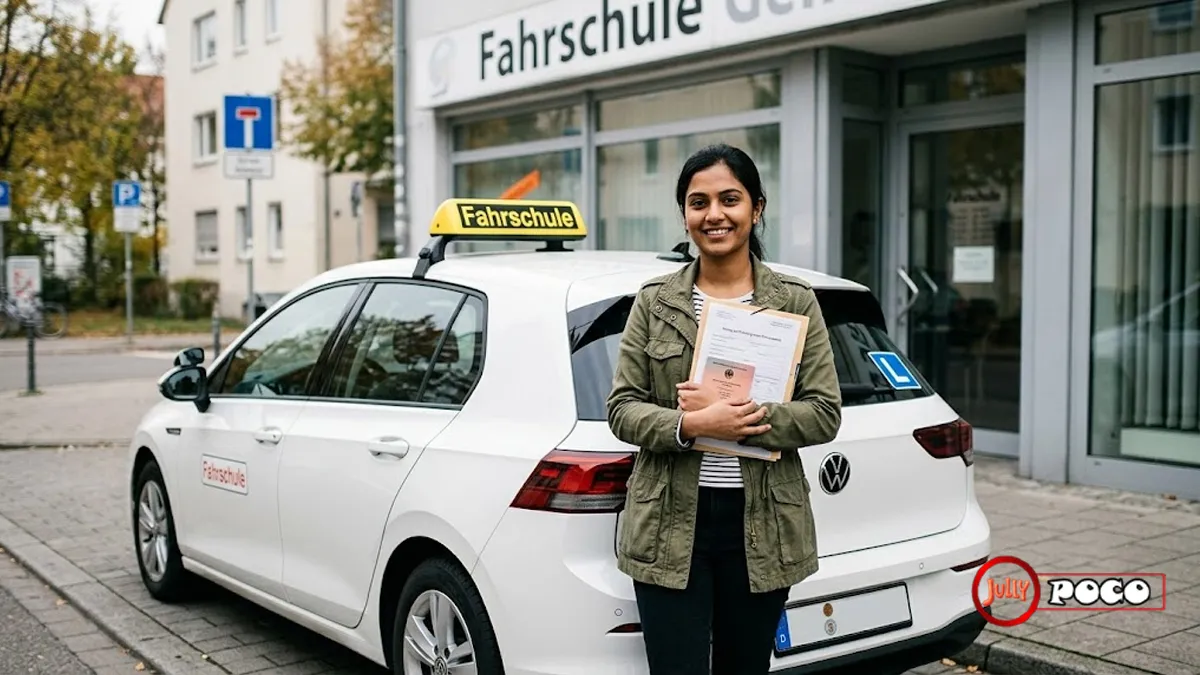
If you are searching for How to get a driving licence in Germany, you are probably already feeling the weight of German paperwork, appointments, fees, and unfamiliar road rules. I have seen many newcomers underestimate the process. They think it is only a few lessons and one exam. In reality, getting a German driving license means dealing with a Fahrschule, the Fahrerlaubnisbehörde, first aid certification, theory apps, mandatory special drives, and a practical test with TÜV or DEKRA.
The process is manageable when you know the steps. It is also expensive, especially for foreigners who need extra lessons or must retake exams. In my experience, the people who succeed fastest are not the most confident drivers. They are the most organized.
This guide explains the complete 7-step process, the real costs, how foreign license conversion works, and the practical tips I wish every expat knew before starting.
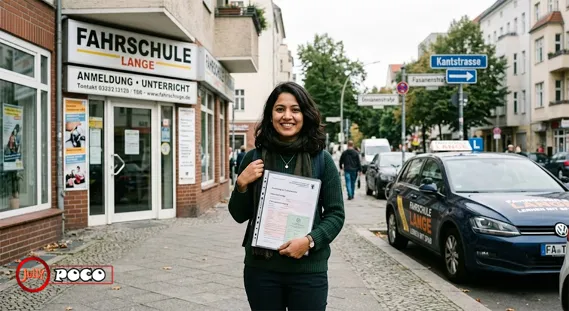
Quick Summary: German Driving License Process in 2026
Getting a German driving license in 2026 usually requires enrolling in a Fahrschule, completing a first aid course and eye test, passing theory and practical exams, and budgeting around €2,000–€3,500. In large cities or after multiple retakes, the total can climb higher.
Foreign licenses may be exchanged directly if Germany has a reciprocity agreement with your issuing country. Otherwise, you may need to take the theory exam, practical exam, or the full training route.
| Step | What You Need to Do | Typical Cost |
|---|---|---|
| 1 | Register at a Fahrschule | €200–€300 |
| 2 | Complete first aid course and eye test | €40–€70 |
| 3 | Apply at Fahrerlaubnisbehörde | €40–€70 |
| 4 | Attend theory lessons | Often included in school package |
| 5 | Pass theory exam | €25–€80 plus school fees |
| 6 | Complete practical lessons | €55–€90 per lesson |
| 7 | Pass practical exam | €120–€300+ including school presentation fee |
Before starting, also think about car ownership costs. A license is only one part of driving life in Germany. Later, you may want to compare insurance, maintenance, fuel, and even business vehicle rules if you run Amazon Business in Germany.
Step 1: Register at a Fahrschule
Your first real step is choosing a licensed Fahrschule, or driving school. You cannot simply apply for the exams alone as a new driver. The school registers you for lessons, prepares you for exams, and presents you for the practical test.
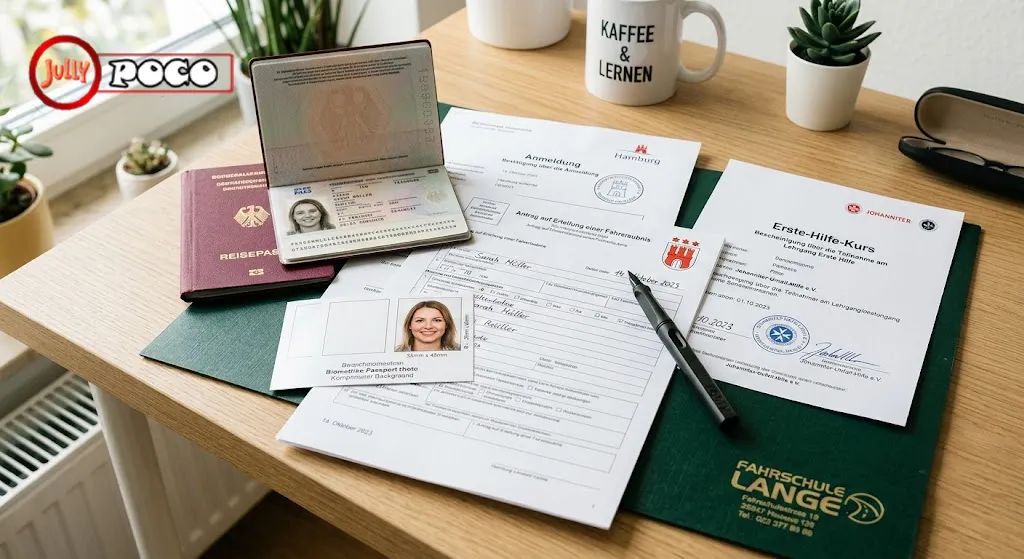
Bring these documents when registering:
- Passport or national ID
- Residence registration certificate, known as Anmeldung
- Existing foreign driving license, if you have one
- Biometric passport photo
- Payment for registration and learning materials
Most schools charge around €200–€300 for enrollment and theory materials. Some charge more if they offer English-speaking instructors or digital learning apps.
In my experience, the best Fahrschule is not always the cheapest one. Ask three practical questions:
- Do they offer English-speaking support?
- How long is the waiting time for practical lessons?
- What is their first-time pass rate?
A school with a lower registration fee but no available instructor for eight weeks may cost you more in the long run.
Class B or B197: The “Automatic Trick” Many Expats Miss
Most people apply for Class B, the standard car license. But Germany also offers B197, which is especially useful if you are nervous about manual transmission.
With B197, you may take your practical exam in an automatic car and still be allowed to drive manual cars later, provided you complete at least 10 manual driving lessons and a short manual-driving competence check during training.
For many expats, this is a smart route. You reduce exam stress by testing in an automatic vehicle, but you do not lose the flexibility to drive manual cars.
Step 2: Complete the German Driving License First Aid Course and Eye Test
The german driving license first aid course is mandatory for almost everyone applying for a license in Germany. It is called Erste-Hilfe-Kurs and usually lasts about 6–8 hours.
You can take it through certified providers such as the German Red Cross (Deutsches Rotes Kreuz), Johanniter, Malteser, or private training centers. The course covers emergency response, accident-site safety, CPR basics, and what to do before professional help arrives.
A typical first aid course führerschein costs €30–€50. The eye test usually costs €6–€10 and can be done at an optician such as Fielmann, Apollo, or at some course centers.
You will receive certificates for both. Keep them safe. You need them for your application at the licensing office.
Trusted resource: You can check course information through the first aid course führerschein page from the German Red Cross.
Step 3: Submit Your Application at the Fahrerlaubnisbehörde
After registering with a Fahrschule and completing your first aid and eye tests, you apply at the Fahrerlaubnisbehörde, the local driver’s license office.
Depending on your city, this office may be part of the Bürgeramt, Landratsamt, or Straßenverkehrsamt. In Berlin, Munich, Hamburg, Frankfurt, and Cologne, appointments can fill quickly. I always recommend booking early, even before your documents are perfect.
You usually need:
- Passport or ID
- Anmeldung certificate
- Biometric photo
- Fahrschule registration confirmation
- First aid certificate
- Eye test certificate
- Existing foreign license, if applicable
- Translation of foreign license, if required
- Application fee
This office approves you for the theory and practical exams. Processing may take several weeks, so do not wait until the last minute.
For official city-level guidance, use your local licensing authority website. A useful example is Berlin’s official page for the driver’s license office fahrerlaubnisbehörde.
Step 4: Attend Theory Lessons at Your Fahrschule
For a first-time Class B license, Germany requires 14 theory sessions of 90 minutes each:
- 12 basic theory lessons
- 2 Class B-specific lessons
These lessons cover traffic signs, speed limits, right-of-way, environmental driving, alcohol rules, safety distances, and accident prevention.
I noticed that many foreign drivers struggle not because they do not know how to drive, but because German exam logic is very precise. A question may test a tiny difference between “must,” “may,” and “should.” That is why translation alone is not enough. You need to understand how German traffic law thinks.
Useful topics to master:
- Right-before-left rule, or rechts vor links
- Priority roads and yield signs
- School zones and pedestrian crossings
- Cyclist safety
- Autobahn etiquette
- Environmental zones, or Umweltzonen
- Stopping distance and reaction distance
If you already hold a foreign license and are only converting, some theory lesson requirements may be waived. Still, many driving schools recommend attending classes, especially if you must take the theory exam.
Step 5: Pass the Theory Exam
The German theory test is computer-based and usually administered by TÜV or DEKRA, depending on your federal state.
For Class B, the exam has 30 multiple-choice questions. Each question carries error points. You fail if you receive more than 10 error points.
There is one important rule many applicants miss: if you answer two 5-point questions incorrectly, you fail automatically, even if your total error score is exactly 10.
The exam is available in German and several other languages, including English. Always confirm language availability with your Fahrschule and test provider.
German Driving School Theory Test Tips
These german driving school theory test tips have helped many learners pass faster:
- Use official or Fahrschule-approved theory test preparation apps.
- Practice daily for 20–30 minutes instead of cramming.
- Repeat all wrong answers until you understand the logic.
- Pay extra attention to traffic signs and right-of-way.
- Learn stopping-distance formulas.
- Do full mock exams under time pressure.
- Do not memorize only the English wording; understand the rule behind it.
We tested several learner strategies, and the most reliable one was simple: finish the full official question bank at least twice before booking the exam.
If your car knowledge is still developing, it also helps to read practical safety topics such as Facts About Car Airbags, Steering Wheel Shaking When I Brake, and engine light is blinking. These are not theory exam replacements, but they make you a more aware driver.
Step 6: Complete Practical Lessons and Sonderfahrten
This is where costs often rise. Germany does not set a fixed total number of normal city-driving lessons for everyone. Your instructor decides when you are ready.
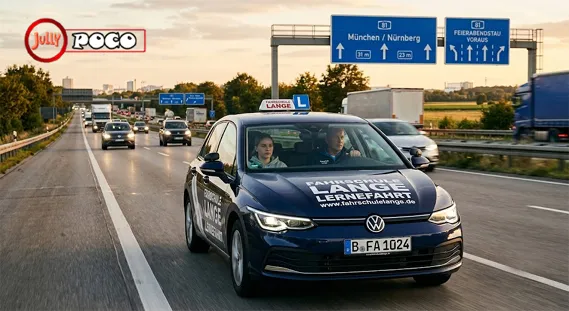
However, there are mandatory special lessons called Sonderfahrten. If you are wondering how many mandatory driving lessons in Germany are required, the answer is at least 12 special driving lessons for Class B.
These are:
| Mandatory Special Drive | German Term | Required Lessons |
|---|---|---|
| Country/federal road driving | Überlandfahrt | 5 |
| Autobahn driving | Autobahnfahrt | 4 |
| Night driving | Nachtfahrt | 3 |
These special lessons are usually completed after you have basic control of the car. They teach you how to handle higher speeds, lane discipline, rural roads, limited visibility, and complex traffic flow.
You will also take regular city lessons before and between these special drives. Many learners need 20–40 practical lessons in total, sometimes more in dense cities like Berlin, Hamburg, or Munich.
The price per lesson varies, but many Fahrschulen charge around €55–€90 per 45-minute unit. Some lessons are billed as double sessions.
Practical Insight: Why Foreign Drivers Still Need Lessons
I have met experienced drivers from the United States, India, Canada, Brazil, South Africa, and the UAE who were surprised by how strict German practical training felt.
German examiners expect:
- Frequent mirror checks
- Clear shoulder checks
- Correct lane positioning
- Smooth clutch or automatic control
- Safe distance discipline
- Exact speed adaptation
- Awareness of cyclists and pedestrians
- Calm behavior in complex intersections
Even confident drivers often need a few lessons to unlearn habits that are normal elsewhere but risky in Germany.
Step 7: Pass the Practical Exam
The final step is the practical driving exam. It usually lasts 30–45 minutes and is conducted by a certified examiner from TÜV or DEKRA.
Your driving instructor sits in the car, but the examiner gives instructions. The exam is normally conducted in German. Some instructors may help clarify directions, but they cannot coach you through the test.
The examiner may ask basic safety questions before or during the drive, such as:
- How do you check tire condition?
- Where is the hazard warning light?
- How do you turn on fog lights?
- How do you check the parking brake?
During the drive, you may be tested on:
- City traffic
- Parking
- Turning and lane changes
- Emergency braking
- Residential areas
- Autobahn or faster roads
- Right-of-way situations
The tüv practical driving exam can feel intimidating, but it is not designed to trick you. It checks whether you are safe, predictable, and legally competent.
Trusted resource: TÜV provides general exam information on the tüv practical driving exam.
Once you pass, you usually receive your German driving license soon after. In some cases, the license is handed over immediately. In others, you collect it from the authority.
How to Convert Foreign Driving License in Germany
Many readers ask how to convert foreign driving license in germany because they already drive in their home country.
Here is the simple version.
EU and EEA Licenses
If your license is from the European Union or European Economic Area, it is generally valid in Germany. You usually do not need to convert it immediately, as long as it remains valid and matches EU rules.
Non-EU Licenses
Most non-EU licenses are valid for only six months after you become a resident in Germany. After that, you need a German license to continue driving.
For converting foreign drivers license germany, the rules depend on your issuing country and sometimes your state or province. Countries such as the USA, Canada, Australia, Japan, South Korea, and others may have partial or full reciprocity agreements.
Possible outcomes:
- Direct exchange without exams
- Theory exam only
- Practical exam only
- Both theory and practical exams
- Full training process
Check the official list through your local authority or the Kraftfahrt-Bundesamt. A helpful official starting point is the Federal Ministry’s information on how to convert foreign driving license in germany.
If your license is not in German or English, you may need a certified translation from ADAC or a sworn translator.
Driving License Cost in Germany for Foreigners
The driving license cost in germany for foreigners depends on your city, your driving ability, the Fahrschule, exam retakes, and whether you can convert an existing license.
A realistic average is €2,000–€3,500. In expensive cities or after repeated exams, costs can exceed that.
| Cost Item | Typical Range |
|---|---|
| Fahrschule registration | €200–€300 |
| Learning app/materials | €50–€100 |
| First aid course | €30–€50 |
| Eye test | €6–€10 |
| Application fee | €40–€70 |
| Theory exam | €25–€80+ |
| Practical lessons | €55–€90 each |
| Practical exam and school presentation | €120–€300+ |
| Translation, if needed | €30–€80 |
The biggest variable is the number of practical lessons. This is why choosing a clear, honest instructor matters. A good instructor tells you what to improve. A poor one simply keeps selling lessons.
Timeline: How Long Does It Take?
Most learners need 3–6 months. Fast-track intensive courses can shorten this to 2–4 weeks, but they require daily availability and quick theory preparation.
Delays often come from:
- Fahrerlaubnisbehörde processing times
- Fahrschule instructor availability
- Exam appointment shortages
- Failed theory or practical exams
- Missing translations or documents
Practical Tips for Foreigners in Germany
Here is what I would tell a friend starting tomorrow.
First, book your Fahrschule early. Waiting lists are common. Second, begin theory practice before your application is approved. Third, budget more than the advertised minimum. Fourth, choose English-speaking support if German driving vocabulary feels overwhelming.
Also, take vehicle safety seriously after you pass. German roads are fast, especially on the Autobahn. Understanding issues like engine light is blinking, Steering Wheel Shaking When I Brake, and Facts About Car Airbags can prevent expensive and dangerous mistakes.
If you plan to use a car for work, delivery, or company operations, business-related topics like Amazon Business in Germany may also affect how you manage expenses and documentation.
FAQs About Getting a German Driving License
1. Can I take the German theory test in English?
Yes. The theory exam is available in English and several other languages. Still, practice with official question banks because the wording can be precise.
2. How many mandatory driving lessons are required in Germany?
For Class B, you must complete 12 special lessons: 5 country-road lessons, 4 Autobahn lessons, and 3 night-driving lessons. Normal city lessons vary by learner.
3. Is the German driving license first aid course difficult?
No. The german driving license first aid course is designed for beginners. It teaches emergency basics and usually takes one day.
4. What happens if I fail the practical exam?
You can retake it, but you must wait for a new appointment and pay additional fees. Your instructor may recommend more lessons before trying again.
5. Can foreigners reduce the cost of getting a license?
Yes. The best way to reduce the driving license cost in germany for foreigners is to prepare thoroughly for theory, avoid exam retakes, and choose a Fahrschule with transparent pricing.
6. Can I convert my foreign license without taking exams?
Sometimes. It depends on your country, state, or province. EU/EEA licenses are generally valid. Non-EU licenses depend on reciprocity agreements.
Conclusion: Start Early, Budget Honestly, Drive Confidently
Learning How to get a driving licence in Germany is less stressful when you treat it like a project. Register with a reliable Fahrschule, complete your first aid and eye test, submit your documents early, study the theory questions carefully, and take the practical lessons seriously.
If you already have a foreign license, check conversion rules before paying for full training. If you are starting from zero, plan for 3–6 months and a budget of around €2,000–€3,500.
Germany’s system is strict, but it creates disciplined drivers. Once you pass, the freedom is worth it: weekend trips, easier commuting, family travel, and the confidence to handle German roads safely.
And after you get your license, keep learning. Topics like Facts About Car Airbags, Steering Wheel Shaking When I Brake, and engine light is blinking can help you become not just licensed, but truly road-ready.
References
- German Federal Ministry for Digital and Transport: validity of foreign driving licenses in Germany
- TÜV SÜD: practical driving exam guidance
- German Red Cross: first aid course information

Job Title: Founder, Chief Editor & Senior Technical SEO Specialist
Institutional Affiliation: Jullypoco Digital Properties
Specialties: Technical Search Engine Optimization | Content Strategy & Publishing | Web Architecture
Muhammad Ali is a seasoned digital content strategist, technical SEO professional, and the founder of Jullypoco. With deep expertise in website management, domain optimization, and search architecture, he orchestrates high-impact editorial frameworks designed to connect global audiences with reliable, high-value information. His commitment to search integrity and evidence-based optimization ensures the highest standards of data accuracy and site performance.
Verify Credentials & Connect:
🌐 Official Jullypoco Author Hub |
💼 LinkedIn Professional Profile |
👥 Facebook Profile
2 Comments
Pingback: Buying a Used Car in Germany Export Plates: Step-by-Step Guide
Pingback: Dating in Germany Expat Experience Tips: Culture, Apps and Etiquette Guide